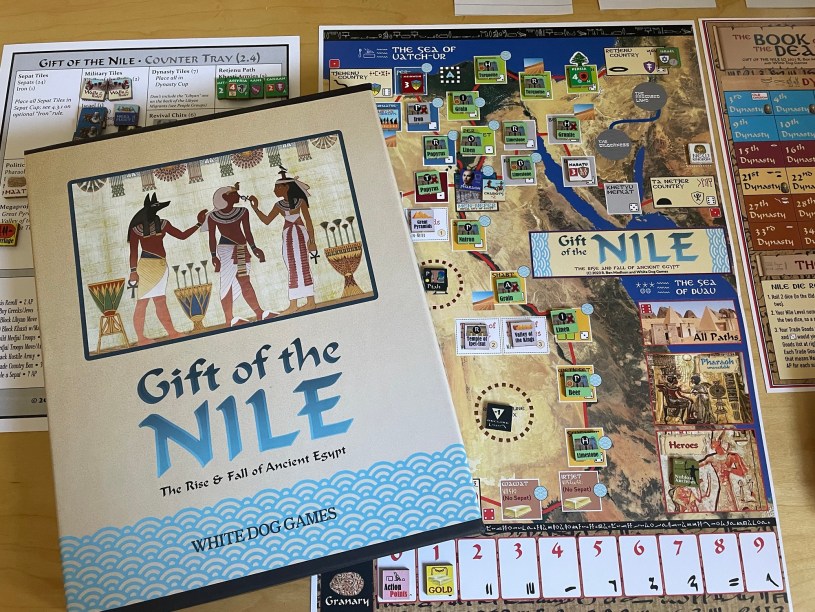
I have really enjoyed my plays of several solitaire games designed by R. Ben Madison. He has a knack for including elements of the history into the gameplay while placing the events into the framework of his chosen system, which is usually the States of Siege Series…but not necessarily always. His newest offering is called Gift of the Nile: The Rise & Fall of Ancient Egypt from White Dog Games and is a solitaire only game that uses the States of Siege Series System and delves into Ancient Egypt and the rule of the Pharaohs covering over 30 dynasties starting with the Old Kingdom in 2,600 BC to the Late Period starting in 700 BC and ending with the intervention of Rome. This is a long and involved game (ranging from 36 turns to something less based on certain conditions happening or a player loss) that really gives the player a good feel for the might and power of the Egyptians, as well as the various threats and enemies they had to deal with to survive for nearly 3,000 years.
In this series of Action Points, we will take a look at the Game Map (board) which shows the various “Paths” used by the assaulting outside Khasti Kingdoms converging on the capital city of Men-Nefer, we will investigate the purpose and makeup of the 3 different draw cups, which is where the game action starts including the Sepat Cup, Dynasty Cup and God Cup, take a look at the Nile Phase and discuss the economy of the game, dive into the 4 different Kingdoms that the player must traverse through safely to come out on top and some of their unique aspects, take a look at the various Actions that players can take during the Actions Phase and why they are important and finally give some strategy pointers on how to do well at the game.

Game Map
The Game Map is an 11″x17″ sheet of thick paper that represents the lower Nile Valley found in Northeast Africa. At the center of the Map is the city of Men-Nefer, the Royal City of Egypt, or as it came to be known in modern times Memphis, which was the capital city of the Egyptian Empire. Men-Nefer separated Upper and Lower Egypt and sat on the west bank of the Nile River. Over the centuries, due to various changes, including sacking by outside invaders and economic turmoil, the city of Men-Nefer lost its economic significance to the Egyptians and was abandoned. But in Gift of the Nile, and the time represented by the game stretching from the Old Kingdom of 2,600 BC to the Late Period starting in 700 BC, Men-Nefer is your heart and it must be protected at all times or the player will lose the game.
Paths
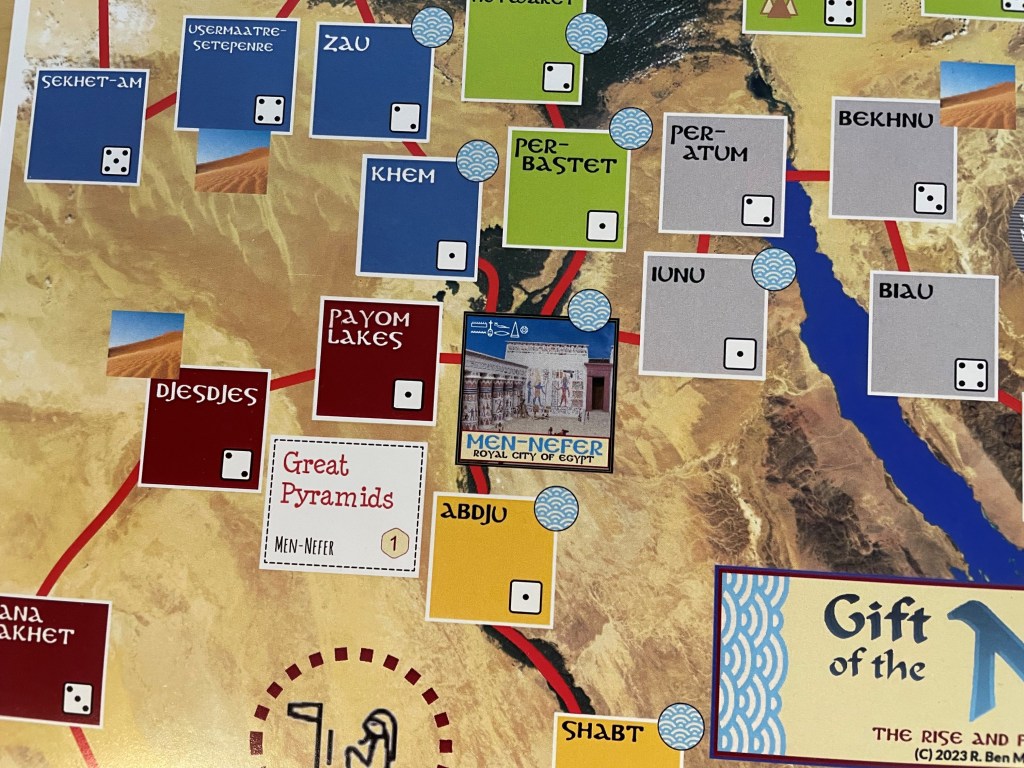
Converging on Men-Nefer are 5 different “Paths” that represent the region or peoples that threatened Egypt. These Paths are made up of a series of boxes called Land Boxes named for the regions they represent and are connected by red lines. This map is setup as a point-to-point movement map and the advancing Khasti Kingdoms will come from their home areas located at the end of the Paths called Country Boxes. The Khasti Kingdoms include the Tjehenu, Retjenu, Libu, Ta Seti and Ta Netjer.
There are 5 boxes in each of the Paths called Land Boxes and there is quite a bit of important information contained in each of these boxes. First, the color is associated with the Path they belong to. The same colored Land Boxes all belong to the same Path and will help the player to keep those Paths distinct in their mind as the game progresses. Also included in each of the Land Boxes is a D6 die face in the bottom right hand corner. This is used when the player is instructed to identify a random Land Box on a Path for things such as Revolts or the rise of a Rival Dynasty. Also, each of the Paths is assigned a number also shown on a D6 die face in the upper left hand corner. This die face is colored red so as to stand out from the other die faces. This identifies the Path as a number. In the picture below, you can see the Tjehenu Country Box identified as Path 1 (see the red D6 die face). The Country Box also contains a few icons that are used to ease game play, especially during the Khasti Evolution and Khasti Advance Phases. On the left side, you will see the symbol of the Tjehenu Country. In the case of Tjehenu Country Box is it shown as an asp (snake). This icon is then referenced on the Book of the Dead or Turn Track and signifies an evolution of that Khasti. Over the centuries, different peoples actually ruled these adjacent rival kingdoms and the game tracks those advances by the Khasti Evolution Icon. When this appears on the Book of the Dead in the current Dynasty Box, the player knows to refer to the rulebook and to flip or replace the counter representing the dominant people of that era on that specific track. On the right side of the Country Box is another icon that links up with the starting icon found on the first ruling people’s Khasti Army Tile for this Path. In the example of the Tjehenu Path, the first Khasti Army Tile is the Meshwesh people. This Khasti Army Tile will be placed on this Path once the Old Kingdom is completed in the 11th Dynasty at the outskirts of the Egyptian rule in the open Land Box next to the Land one past the Medjai Troops Tile on that path.

One other note about the icons in the Land Boxes. As you can see, some of the Land Boxes have a blight blue circular icon in the upper right hand corner of the box. This is called a Nile Icon and represents the Nile River and shows that this Land Box is on the banks of the river itself. This is only used in the game to denote this as a Nile River space for the use of the Mera Fleet Hero Unit. This unit can be built and used by the player to attack Khasti Army Tiles located in these Nile River Land Boxes.
Deserts and Other Special Icons
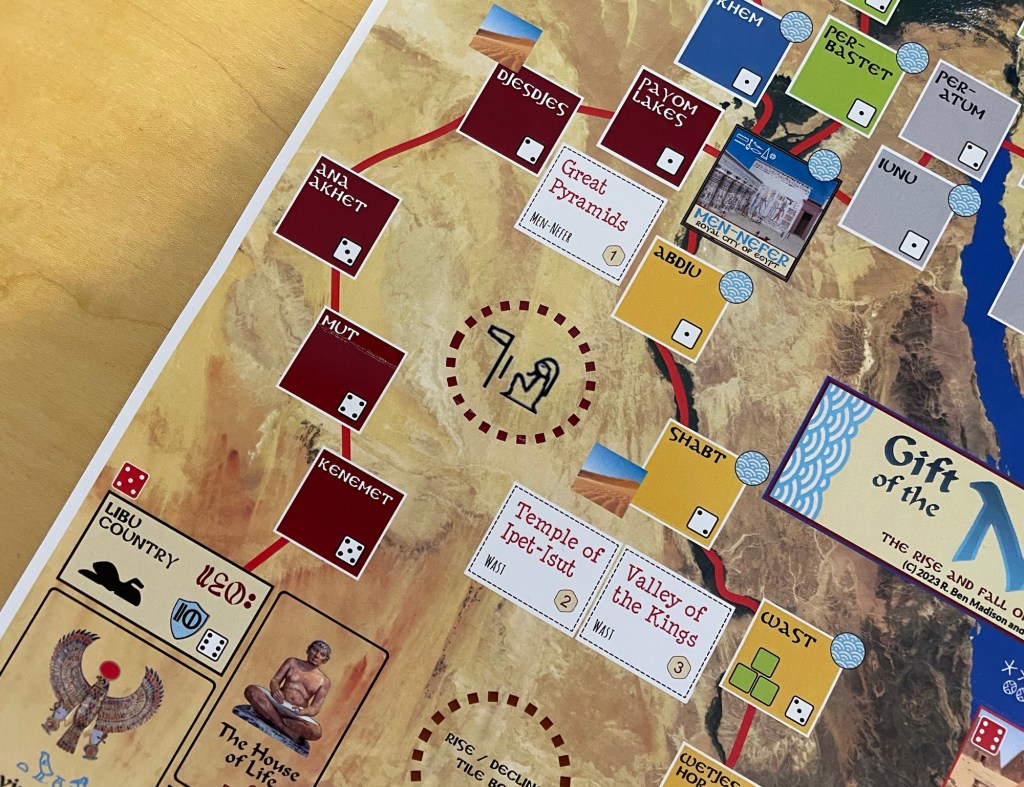
In the picture below, you can see the 3 Paths located in Upper Egypt, including the Tjehenu, Retjenu and Ta Netjer Paths. Tjehenu is identified as Path 1 (by the red D6 die face), Retjenu as Path 2 and Ta Netjer as Path 3. I really like the use of the different colors as it immediately pulls the eye toward each of the Paths and helps keep them distinct and separate even though they converge on Men-Neher and kind of bunch up in the lower numbered Land Boxes. I want to point out a couple of other key symbols and special boxes found on this portion of the Game Map.
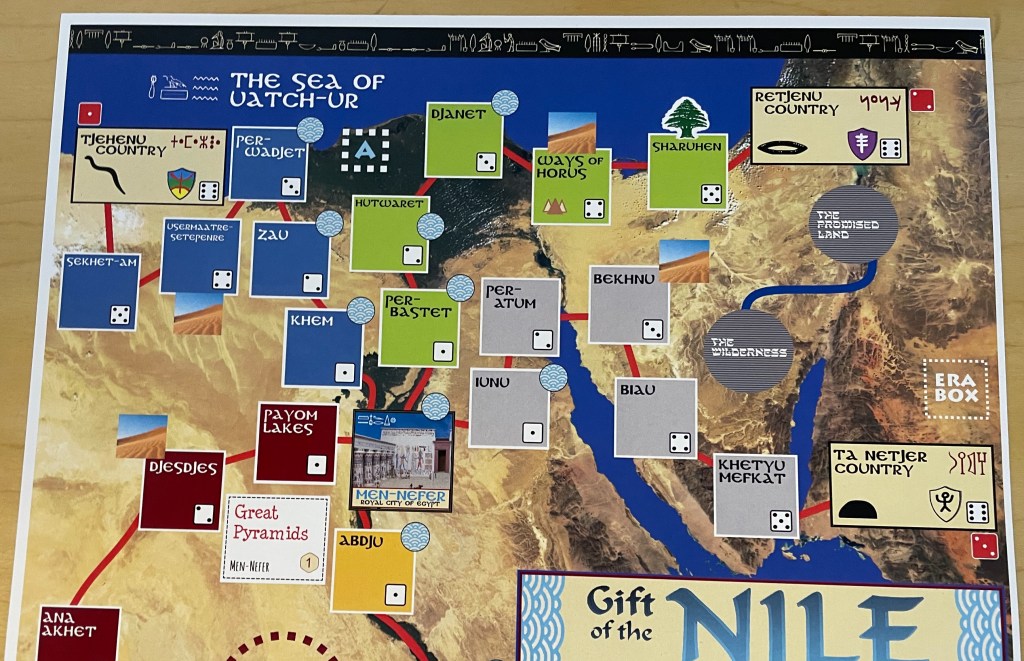
First, you will see the presence of sand dunes (smaller picture found in Land Box 4 on both the Tjehenu and Retjenu Paths and Land Box 3 on Ta Netjer Path) and this represents that this Land Box is a Desert. As such, this box will not have a Sepat found in it as the player advances outward on this Path. Normally, as the player conquers and incorporates the Sepat located in a Land Box, they get a recon look at the type of Sepat that is found in the next Land Box. But in the case of a Desert, there will be no Sepat placed here. In order to settle this area, and gain some economic benefit through the development of one of the 9 different Trade Goods found in the game, the player will have to take what is referred to as a Colonize Action where they will pay a number of Action Points from 1-5 and can reach into the Sepat Cup and randomly draw out 1 Sepat. If the Sepat value is less than the number of AP’s they spent for the Colonize Action, they will have successfully Colonized the area and can place that Sepat in the Desert and will have control over it. They can then Temple that Sepat or flip it over to gain an upgraded Trade Good that can provide additional Action Points and also will now defend as the Khasti Army Tiles advance into the Land Box. If the player doesn’t spend Action Points to take a Colonize Action these Deserts will sit empty and can be controlled by the player but will not give any benefit.
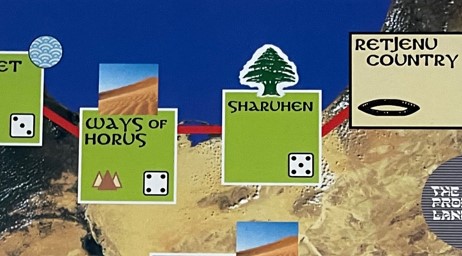
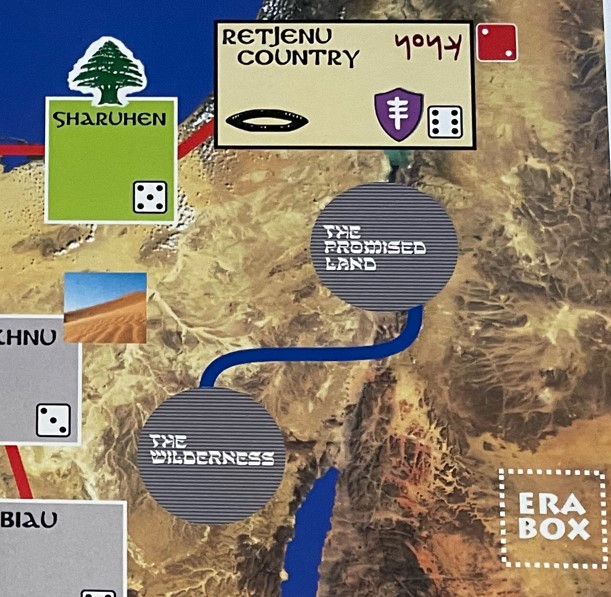
There are a few other special icons found on the Retjenu Path. In Land Box 4, the Ways of Horus, is the Cone Icon (that is my name for it). This icon means that the player can build Walls of the Ruler on a path for a discount. Normally, to build these Walls of the Ruler the player must pay 6AP but if Ways of Horus is controlled they will receive a 1 AP discount and can accomplish the project for the discount price of 5 AP. Also found Land Box 5 Sharuhen is the Tree Icon. This is used by the player to purchase the Mera Fleet Hero for a discount of 2 Gold down from 4 Gold if this area is not controlled. As gold is a rare commodity, and much harder for the player to obtain, this is a huge advantage but is very challenging to control as you must hold it in the 18th Dynasty to use the Mera Fleet.
The Wilderness and The Promised Land
As you might imagine, the Jews play a fairly significant role in the history of Ancient Egypt and in the game. They were enslaved for a period of roughly 400 years and then this rabble rouser prophet named Moses stood up and demanded that Pharaoh release his people. When he didn’t, there was the small thing of 10 plagues that vexed Egypt until Pharaoh finally gave in after the death of his eldest son during the 10th and final plague and released the Jewish People into the wild. Over the course of the game, there are several random events that will occur as the player interacts with the Chronicles of Manetho, which is a stand alone sheet that identifies various historical events with the player rolling a D6 and adding onto that number the current Dynasty. Several of these events involve the Jewish People with their commencement of enslavement, to their release by Pharaoh, their wanderings in the Wilderness, arrival at the Promised Land and their building of the State of Israel. All of these events are tracked on the Game Map. The Wilderness and The Promised Land are found in the upper right hand quadrant of the Game Map just below the Retjenu Country Box. Each of them are represented by a gray hatched circle connected by a meandering blue line. Finally, once the Jews have reached The Promised Land, a future event will cause them to appear in the Retjenu Country Box as they have become and established nation that will threaten Egypt along with the current Khasti Kingdom from that box.
The Megaprojects – Great Pyramids, Temple of Ipet-Isut and Valley of the Kings
In the center of the Game Map are located the 3 Megaprojects Boxes where the player can invest in and build the Great Pyramids, Temple of Ipet-Isut and Valley of the Kings. These are marked with a white box with an outside dotted line around the edges of the box, the name of the Megaproject that can be built there and then a hexagonal cream colored shape with a number in the bottom right hand corner. This number denotes the order in which these structures can be built by the player. Also, if the player doesn’t control the Wast Land Box they will be unable to build those 2 Megaprojects. Megaprojects are only useful in the final scoring for the player when the game is over. They will each provide the player with 5 Survival Points each at the end of the game. The player can also loot the Megaprojects they have built by flipping their counter over, rolling a D6 and gaining that many Action Points. While this is very useful and can really save your bacon at a tense time, this will reduce their Survival Points provided to just 2 each.
Gold – Irtjet and Wawat Land Boxes
The player can obtain gold to use to build their economy by controlling 2 Land Boxes on the Ta Seti Path. These Land Boxes are Irtjet and Wawat located at the end of the Ta Seti Path adjacent to the Ta Seti Country Box. These boxes are located in Nubia and represent the vast gold deposits and mines in this country. If you notice on the Game Map, there is a note that these 2 Land Boxes cannot contain a Sepat but when the player has pushed the Khasti Army Tile here back to the Ta Seti Country Box, they are considered to control them. Control of these Land Boxes will provide the player with 1 gold per Land Box so there is the potential to gain 2 gold each round. You will also notice that they are Nile River Land Boxes as they carry the light blue wave icon. This should tie into your mind the connection here as control of the gold allows for the building of the Mera Fleet and the Mera Fleet is best used to defend these two Land Boxes as they are vitally important to the player to gain extra Action Points and also be able to purchase and repair the various Hero Units.

Administrative Boxes
There are also found on the Game Map various Administrative Boxes that track several aspects of the game or act as a holding box for used or exhausted units. The most important of these is the Granary Track which allows the player to track their current Action Points and Gold. These come with different markers that the player simply places in the appropriate numbered space to represent their accumulated Action Points and Gold after a Nile Phase. The spaces are numbered 0 through 9 and the most of either of these resources a player can have at a time is 9. One of the thematic elements here that I really liked was the inclusion of the Egyptian Hieroglyphic for the numbers. This was just a nice touch to the overall feel and look of the Game Map!
Above and to the right side of the Granary Track is located the Pharaoh Unavailable Box and the Heroes Box. These are holding boxes for when those units have been used for their special abilities. Once used they are placed in these boxes to return at the end of the current Dynasty. Located to the left is the Revival Chits Box, The House of Life Box and the circular dotted line is the Rise/Decline Tile Box. These boxes are also holding boxes for any Ma’At Tiles or Revival Chits that the player purchases with their Action Points. They are held here until used and then will be either taken off the board and discarded from the game or located to a certain spot on one of the Paths. The Rise/Decline Tile Box is the holding area for the Rise or Decline Tile that will be decided during the God Phase and depending upon which of the God’s are drawn. This is a very important aspect of the game and is important to remember as there will be either bonuses to your Actions taken on a specific Path or negatives to those Actions and this piece helps you to keep that in order.

I have really enjoyed my experiences with Gift of the Nile! The Game Map is a work of art, although it is very crowded and fairly busy, but each of the parts of the map are used in the game and are important for the players to understand. I found that the map actually aids you in playing the game and has several built in reminders of things that the player needs to keep in mind. I also really like the thematic elements of the map, from the images to the presence of Hieroglyphics and the use of color, and feel that the overall experience is one rooted in the history and culture of the Egyptians. I am very much going to continue playing and am working on several video pieces for the game including a few playthrough videos (Part I – Old Kingdom – 3rd Dynasty through 10th Dynasty and Part II – Middle Kingdom (11th Dynasty through the 17th Dynasty) are completed and just need to be uploaded to the channel, a review video and I have already completed a fairly in-depth First Impressions style post that you can read at the following link: https://theplayersaid.com/2024/04/03/first-impressions-gift-of-the-nile-the-rise-fall-of-ancient-egypt-from-white-dog-games/
We also posted an interview with the designer and you can read that on the blog at the following link: https://theplayersaid.com/2024/03/11/interview-with-r-ben-madison-designer-of-gift-of-the-nile-the-rise-fall-of-ancient-egypt-from-white-dog-games/
In Action Point 2, we will investigate the purpose and makeup of the 3 different draw cups, which is where the game action starts including the Sepat Cup, Dynasty Cup and God Cup.
-Grant
 The Players' Aid
One of the things I enjoy about Ben Madison designs is learning all the iconography on the game maps. Seeing how they tie into the minor rules that add so much theme is a fun part of process for me.
LikeLiked by 1 person
Yes agreed. I would say that I find that I missed a lot of these types of tings though on the first few plays but pick them up on later plays.
LikeLike