
Triumph is a multi-player game designed for 2-5 players who control an influential family in ancient Rome. These families will use their symmetric family decks to bid for positioning to gain control of various political offices to perform actions like build and occupy buildings, lead great campaigns against the barbarian invaders on the frontier, place influence in the form of clients in the various provinces of Rome, all in order to gain prestige and power and remove their enemies from the board. The game is a semi-cooperative effort that means all players will lose if any barbarian army enters the gates of Rome but only one player will stand supreme as a great and memorable historical leader in the development of the greatest empire the world has ever known.
We were able to play a prototype copy of the game recently and really had a great time with the mechanics and the production of the game. This one is really very good and keeps players involved and engaged with negotiations, backstabbing, and bluffing. There never was a dull moment in the game and the thematic integration of the theme with the mechanics worked really well to create a fun and interesting experience. We reached out to the design team and asked them a few questions about the game to give you a bit of a better idea behind the design.
If you are interested in Triumph, you can back the project on the Kickstarter page at the following link: https://www.kickstarter.com/projects/phalanxgames/triumph-0
Grant: Why Rome? There are so many board games about Rome out there, so why did you decide to pick this setting and theme?
It’s true, Rome is everywhere. However, if you take a closer look at it, you will notice that most of the games dealing with Rome are about its imperial period, not republican. And when they are republican, they typically deal with the last days of the Republic, Julius Caesar, or – in the military context – the first two Punic Wars. Games about the earlier Republic, specifically its politics and growth from a city-state into a great power, are few and far between.
Grant: What is the overall design goal of Triumph?

Now, one of those games we mentioned is the 1990 classic, The Republic of Rome. Both designers of Triumph love that game and wanted to bring what’s best about it – the emotions it evokes, the feel, and its political shenanigans – into the 21st century, in a design that’s streamlined, quicker to play, and even more replayable. A game that’s modern but still sticks to the idea of negotiations, and making deals with other players, as the key part of gameplay. We hope with Triumph we achieved that goal. One other design goal was to bring closer the history of republican Rome, to show how it worked at the very top; the political reality ancient Romans faced, and the contest between the most powerful noble families to gather as many offices and triumphs – and wealth, of course – as possible.
Grant: Why is the game called Triumph?
To be granted a triumph – a procession across the city of Rome showcasing one’s military victory – in the republican period was to achieve the highest possible glory and honor. Triumphs may have lasted just one to three days but the way Romans talked about them, discussed their details, and used triumphal language to describe other elements of social and political life, points to them being – as some historians strongly suggest – at the heart of Roman republican culture. Every commander aspired to a triumph, and in a significant way, it fueled Rome’s expansion. Ultimately, as the republican institutions started to crumble, it was those politicians who triumphed most, like Caesar or Pompey the Great, who vied to become more than temporary, elected leaders – which is the player’s goal in Triumph.
Grant: How is the game tied to its theme and Roman history?
You’ve probably heard of cursus honorum. For those who’re not familiar with it, it was a ‘ladder of offices’ each ambitious Roman citizen of senatorial rank was supposed to climb to eventually reach the offices of Consul and then Censor. In Triumph, all the prized offices of cursus honorum are up for grabs, mirroring the historical reality of political life in the Roman Republic. In fact, nearly every aspect of the game, from the politics, through clients (which is also a very specific Roman term) to the military conquest, reflects history, though simplified enough so that you can play the game in an hour and a half, or twice during an evening. The game is steeped in Roman nomenclature, which is so familiar to us due to its heavy use in our modern republican institutions, that we sometimes forget it originally came from republican Rome. Take for one the US Senate that gathers on Capitol Hill, a name derived directly from Capitoline Hill, the heart of the ancient city of Rome.
Grant: What do you believe the game excels at?
At keeping you on your toes for 90 minutes, plain and simple. Also, at giving you the feel you’re never out of options no matter how bad the situation is on the board, and a taste of what it might’ve been like to be an ancient Roman politician.
Grant: What are the main mechanics used?
Triumph is primarily a bidding game with area majority scoring in the provinces on the map and some die rolling in combat. As for bidding, it involves card management as well since you have 6 cards in your hand for 5 bidding phases, and you’re going to use all of them by the end of each round.
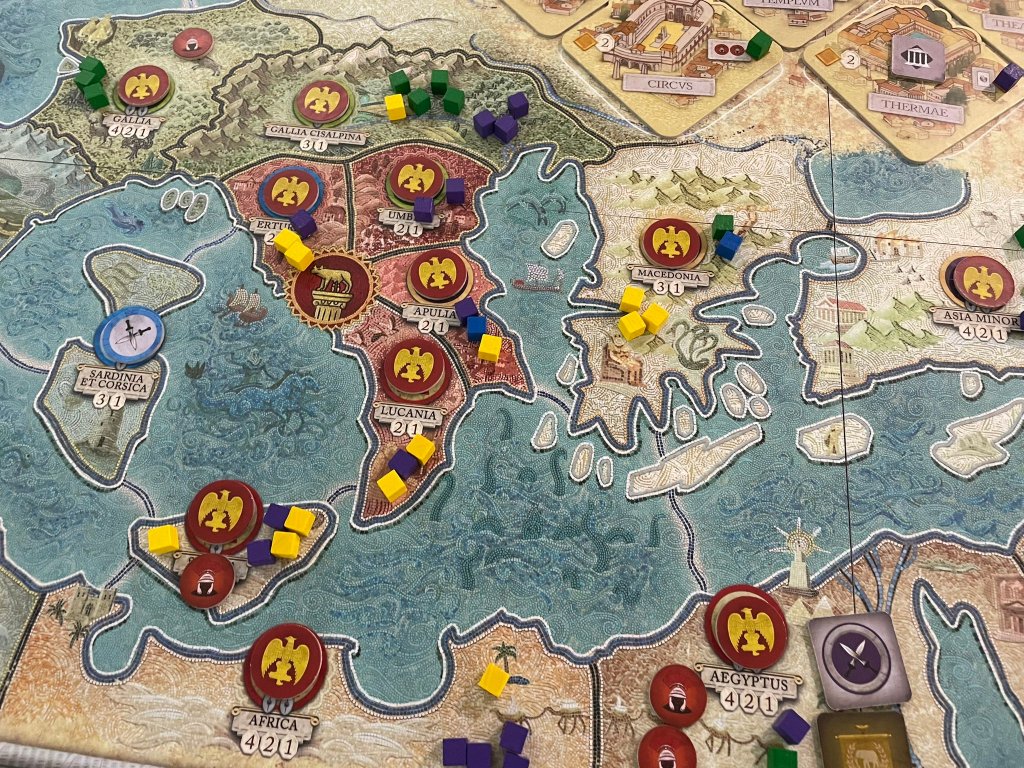
Grant: How does the bidding phase affect the game?
Bidding takes place in 5 out of 7 phases in the game so it’s the core element of Triumph. Most offices you’re bidding for allow you to place new Clients (cubes) on the board or grant you Talents (money). Some offices, though, offer special benefits. For example, Tribunes draw useful Law cards, Censors pick which Buildings to construct in Rome (there’s always a selection of those, especially if you have all the expansions) and Consuls choose where to lead military campaigns.
Grant: What is the makeup of the family cards used for bidding?
All Family cards have an Influence value from 0 to 5, and all players have exactly the same set of 6 cards differentiated factionally by their colors, illustrations, and names (hence, you can expect to see nearly all major Roman political and military leaders of the republican Rome represented in the game). Those valued at 0 may not be worth much in a bidding phase, but they do provide 1 Talent for the player. And those valued at 1 are useful in another way: it forces you to play another card. Cards valued at 2-5, if played in the Conflict Phase (for the offices of Consuls and Legates), grant extra Legions in military campaigns.

Grant: Can you share some strategy thoughts about bidding?
As you can imagine, with just 6 cards in your hand (and 1 that always has to be played with another) and 5 bidding phases, you have to carefully pick your fights. One strategy is to diversify your sources of Prestige (victory points), keep your opponents guessing, and try to gain different offices each round. Another is to focus on just two or three offices, and try boosting the Influence value of Family cards played for them with Law cards. You may also approach bidding on the basis of negotiations – or, say, pay off your opponents to bid low if you’re overflowing with cash or intrigue markers (which is a kind of catch-up mechanism). The options before you are limitless.

Grant: The game is focused on area majority to gain victory points. How do players put out their Clients to control areas?
There are lots of ways to increase your majority in a Province. Winning biddings and thus becoming Roman officials – Tribunes, Censors, Aediles, and the Praetor – is the most straightforward way of putting your Clients out there. Conquering a Province will allow players who took part in the campaign to place their Clients there, too. Also, each Law card can be played to put a Client in any Roman-controlled Province.
Grant: How is the game semi-cooperative?
There’s one aspect of Triumph that forces players to work together, and that’s in beating back the Barbarian invasions threatening Rome and in campaigns in general. Though it sometimes happens, usually no single player acting as a Consul or a Legate can successfully defeat enemies of Rome such as Hannibal or Mithridates; victory requires a certain measure of carefully negotiated cooperation. With two leaders on the battlefield, the chances of winning a battle and conquering new territories are simply much higher.
Grant: How do players work together to defeat Barbarian invaders?
It’s rather simple. In the Conflict Phase, one or more players can decide to move their Leaders (Consuls or Legates) into the Province with a Barbarian Commander. They take their Legions with them, often paying for the use of Auxiliary Legion and sometimes playing cards to influence the battle. Then, the Major Leader, a player who started the campaign, rolls the dice against the Barbarian die roll, and if successful, the Barbarian Commander is defeated, presumably dead or taken as a prisoner to be presented in chains to the Roman public at a triumph.

Grant: What type of spoils are gained from combat and how do players earn Prestige from it?
First, the Major Leader gets to place 2 Clients in a Province. Then, if a Barbarian Commander has been defeated, he gets the higher-valued Prestige depicted on his card, and gains the number of Talents also depicted there. If he was supported by a Minor Leader, he may take those Talents all for himself or give them away and gain 1 Prestige for each 1 Talent given. Most of the time this is what you’re going to be doing, unless you’re really strapped for cash. The Minor Leader also gets Prestige, but a lower number of those.

Grant: What is the role of Law cards?
They act as special actions that can be used at the time of your choosing. Usually, the Law cards give you some benefits like new Clients or extra Talents, but some cards work against your opponents, disrupting their plans. They generally keep things interesting, and if it happens that you don’t really have a use for a given card, you can always play it to place a Client in a Province.
Grant: Can you share a few examples of these Law Cards and explain their game use?
Sure. For instance, we have a card “O tempora! O mores!” which lowers the Influence of an opponent’s Family card during a bidding phase – a pretty vicious, that one – or a card that’s almost the opposite in effect, “Common cause”, which increases the Influence of two cards, yours and one belonging to an opponent. There’s also a card like “Rome wasn’t built in a day”, granting you 1 Prestige per each unclaimed Building in Rome. Law cards are tied to every aspect of the game, from bidding, through combat to placing Clients – in fact, most of them deal with Clients.

Grant: How does the art create a thematic experience? Who is the artist?
Let’s start with the latter: Bartek Jędrzejewski, our art director, whom you may remember from HUANG, Coalitions, or our two “Race to” games. We couldn’t praise him enough. What he came up with in Triumph is utterly brilliant: a stunning mosaic painting for the main board which ties perfectly with the ancient Roman style. The Law cards are also unusual in the sense that instead of typical illustrations, they feature depictions of Roman-style marble bas-reliefs that decorated (and still do to this day) numerous Roman buildings. It’s all there, including various components adorned with the letters SPQR, to convey the feeling of being in control of the Roman Republic. So it’s not just the mechanics that tie into how Rome really worked, with political offices and military campaigns at the forefront, but also the graphics based on ancient Roman art.

Grant: How do players win the game?
It’s as simple as it gets: by scoring the most Prestige, i.e. victory points. But how you’ll get to that point is something quite different. I mentioned the area majority, and yes, you’ll probably score most of your Prestige with that. But there are other ways to get Prestige, from winning Campaigns and playing Law cards at just the right moment, to investing – since it costs you Talents to upkeep both – in Buildings and Games. There are multiple paths to glory and donning that emperor’s toga, and the expansions add even more – Public Goals, pirates you need to defeat, and such. It’s best not to stick to just one source, though, not with opponents doing their best to foil your plans.
Grant: What other games is PHALANX currently developing?
We have a couple of games that are nearly done, like the beautiful new edition of Unhappy King Charles by Charles Vasey and 1920: Nest of Eagles, our hex-and-counter game about the Polish-Soviet War. We have multiple other games in the pipeline, at different stages of development, but I’d like to focus on three.
First, there’s the new edition of the legendary Hannibal & Hamilcar. It’s not a reprint, mind you! We decided to split them into two separate games and move away from miniatures being a core part of the box. In other words, both games, Hamilcar and Hannibal, will be separate and available with cardboard general standees and counters (you’ll be able to pick whatever suits your fancy). No need to create specific decks for each game, and juggle components from one game to another, as was the case in the previous two editions.
Second, we’re working on a new edition of another vaunted title, Hands in the Sea. Yes, we know we’ve got a lot of games about ancient Rome, and that’s another one about the Punic Wars, but, hell, we just really like that period of history, what can we do? Our edition will get the standard PHALANX treatment – new graphics, a revamped rulebook with streamlined and easier-to-learn rules, new player aids, etc.
Third, we have a brand new title planned, not a new edition or anything like that. The game is called Lords of Heaven and it tackles the history of the two first crusades. It’s an area majority and card placement game for 2-4 players where you play as the leaders of one of four asymmetric factions: the Latin Christian Crusaders, the Orthodox Christian Byzantine Empire, the Shia Fatimid Caliphate, or the Sunni Seljuks. It’s an interesting blend of mechanics that’s telling a great story, and we can’t wait to share more details with the public.

Thank you so much Valdemar Gumienny & Raymond de Maria for your work on the game as well as doing this interview for our readers. Having played the game, we really are excited about this one. Particularly with the new expansions that will be included and all of the new possibilities that will add to expand an already fantastically interesting game.
We posted a preview video for the Kickstarter campaign and you can view that at the following link:
If you are interested in Triumph, you can back the project on the Kickstarter page at the following link: https://www.kickstarter.com/projects/phalanxgames/triumph-0
-Grant
 The Players' Aid