
Not often do we play a wargame that uses Euro mechanics like deck building or worker placement. But, in our everchanging and evolving hobby, we are seeing all different types of games that use these traditional board gaming mechanics to great effect. I look at it like a hybridization of two things. Different. Unique. Each having their own focus and strengths. But, when we merge them together, using the parts that are best in each, to make the whole better, we get a new creature. A better thing. And we are seeing this be successful time and time again over the past 5 years or so.
In 2023, there was a Kickstarter campaign from a small French publisher called Fellowship of Simulations that promoted a worker placement wargame on the Napoléonic Wars called Napoléon’s Conquests (or Les Conquêtes de Napoléon) covering the period of 1795-1804. The game uses multi-use cards and sees players placing their Advisor pieces onto a limited number of action spaces to choose what actions they will be taking during their turn. While the game is marketed as a worker placement wargame, this game is truly a wargame and is focused around campaigning and building military alliances against the Emperor Napoléon and his mighty forces. Recently, we were able to play a 4-player game (the game does go up to 5 players) and while we had some trouble with the rules and getting started, I think that once we got going everyone enjoyed what was trying to be modeled. I want to share my thoughts with you on this interesting game in this First Impressions style post.

How Does the Game Use Worker Placement?
One of the first things that we need to discuss is how the game uses worker placement. Each of the player factions (France, Great Britain, Russia, Austria and Prussia) has a set of Advisor tokens that are thick wooden disks that can be placed into one of several different action spaces on the left side of the game board called Action Zones. These Action Zones are divided into 1 of 6 different categories called Domains including Initiative, Finance, Morale, Society, Military and Diplomacy. Each of these categories has a specific amount of available spaces with some having more than others (Military for example has 6 different spaces while Finance, Morale, Society and Diplomacy have just 3 such spaces each).
These spaces each grant the player who placed an Advisor token into that space a bonus, sometimes in the form of drawing an extra card, gaining gold (Franc Germinal or FG) or improving morale, followed by an allowable action to play a card from hand that matches that category. The player decks are made up of multi-use cards that each are associated with one of the 6 categories mentioned above. These cards are color coded to the areas with yellow being Finance, purple Morale, pink Society, Military red and Diplomacy orange.

The disks will be placed by the players in Initiative Order, which is shown at the top of the Action Zones on the board, and once an Advisor token has been placed in a space, it will be unavailable to the other players. They can still place in that domain if there are other spaces that are not yet taken. This placement reminds me of one of my favorite games of all time Dominant Species from GMT Games where the same type of placement rules apply. This creates somewhat of a mad scramble for the best positions, not only for the granted bonuses, but just to take the action associated with that domain. This does require players to somewhat have a plan in mind of what they wish to accomplish that turn but to be flexible and take other actions when their chosen actions are no longer available that make the most sense for that turn.
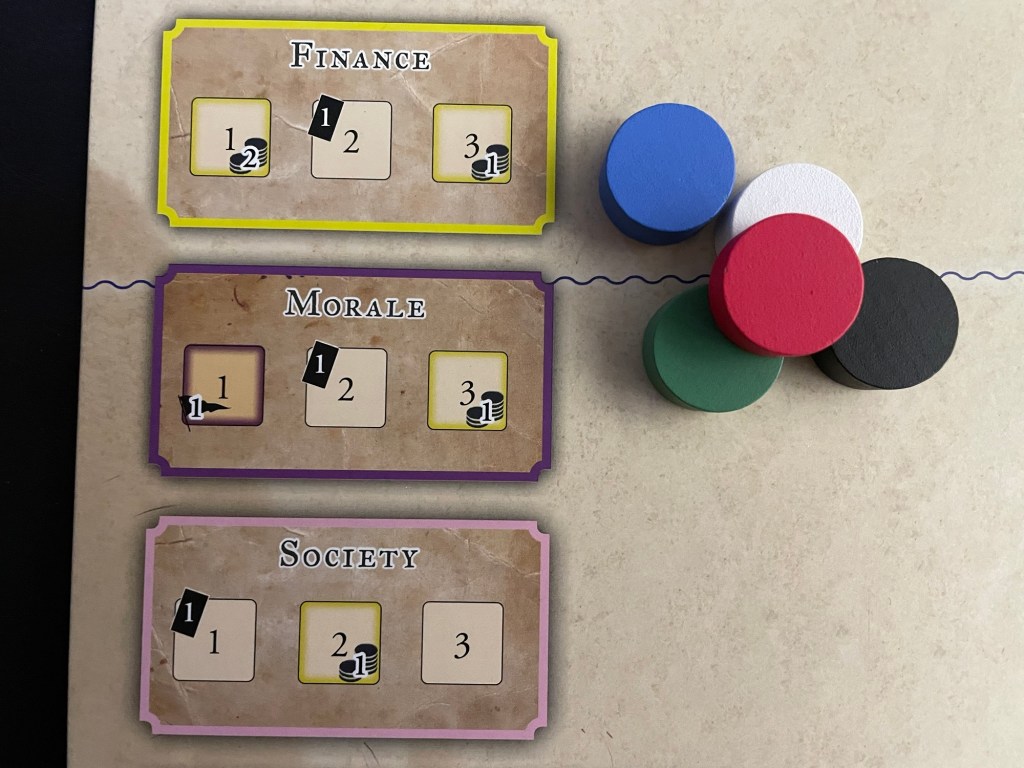
After all of the placement has been completed, and each of the players has placed out their 3 Advisors (the French have 5 to place), the resolution of the actions takes place from the top of the Action Zones area on the board from left to right until all actions that were selected have been taken. Once again, the placement of an Advisor just reserves a place at the table for the player and they then have to adjudicate those actions in turn. In addition to the action granted, such as gaining gold, moving up in the Initiative Order or even purchasing Movement Points (yes you read that right you have to purchase Movement Points!) or units, each player can then play one card from hand that matches the color of that domain. These can be immediate effects such as with a Morale card where the player’s morale level will be increased by 1 or 2 spaces on the Morale Track or will take the part of an extra military unit purchase opportunity. One of the keys to the game is managing every aspect of the war including the obvious military logistics and units, but also social issues, morale, finance and diplomacy.

I really liked the worker placement mechanic used in Napoléon’s Conquests as it created some really interesting decisions for the players but also enforced a focus on planning and overall administration associated with overseeing such a widespread and global conflict. Really well done and a great thematic way to start the game. Now that we have covered the action selection mechanic with worker placement, we need to take a bit of a deeper look at the multi-use cards that players are able to use when resolving their chosen actions.
The Multi-Use Cards
The game is somewhat card driven in a sense but more specifically uses multi-use cards to give the player various abilities, options or even special bonuses in battles. The difference with these cards is that they don’t have Operations Points that can be used to take actions but instead have at least 3 colored tabs shown on the right side of the card that coincide with the various Domains mentioned above including Finance, Morale, Society, Military and Diplomacy. This is the tie back to the worker placement mechanic as when players place their Advisor disks into one of the spots they get the bonus and then can play a card from their hand to manipulate the game state or board. That card has to match the color of the space they are in when played so if the Advisor is in a Finance space, they must play a card with a yellow tab.
Before we get further into that, I wanted to let you know that there is a specific deck for both the forces of Napoléon and France and a shared common deck that is used by only the Coalition players. They each roughly have the same amount of cards in each but the thing about this game is that with the Coalition sharing the deck, this really can cause some interesting situations with them and their cards. They may or may not be able to do what they want to during their turn because they only have a few cards. But, this then creates a need for the Coalition players to take actions where they can also pick up bonus cards as these are very important to them as they provide different options that they might not have had when they placed their Advisor tokens.

Back to the colored tabs on the cards. The player has got to be able to prioritize the actions that are most important for them to take this turn based on what cards are in their hand. If you look at the cards below, each have 3 different colored tabs meaning that the player has access to play these two cards in all 5 of the Domains. There are two pink tabs that are tied to Society, 1 purple tide to Morale, 1 yellow for Finance, 1 orange for Diplomacy and then a red tab that provides a specific event or option to purchase additional units.

The numbers in the tabs are important as that tells the player the relative power of that action. A 1 in the tab will mean that it will provide 1 increase of Morale (purple), 1 increase of Society (pink), act as 1 point for Diplomacy actions (orange), which normally takes 2-3 points so you may, 1 coin in Finance but the red tabs are very different. They do not contain numbers and are usually blank but then link to the event text in the red box located below the picture on the card. Sometimes though in the red tab will be a crossed sabre symbol which means that card is an event that will be played before, during or after a battle to provide some additional benefit. There are also Diplomacy events on the cards and they typically allow the player to look at Napoléon’s hand of cards. This can be useful to understand what might be coming in battles in the form of Strength Point increases or reductions.

There are also some cards that provide a negative number and these are typically only found on the Coalition cards. These negative numbers in the colored tabs are used by the Coalition player who plays them to effect Napoléon and his forces by reducing their Morale, Society or reducing their treasury. There are not a lot of these type of cards though so when they are drawn, the Coalition player really has to think about their use and whether it is best to use them against Napoléon at that time, hold them over until a later turn or use them for the other printed actions.

The cards are a very well done part of the design and were pretty intuitive and easy to pick up and understand. As in any game that uses cards, the player must understand when to play the cards and when to hold onto them for a more effective or efficient use in a later turn.
Players Must Balance Economic, Social, Diplomatic and Military Priorities
I remember when I backed the game on Kickstarter and was reading through the description of the game by the designer and publisher. I got the feeling that they were really trying to be careful to not classify the game as a wargame or simulation of the military events of the period. Probably as a marketing ploy to not scare away from prospective buyers with more of an inclination to play Euro style games. But, when players are focused on building armies and navies, moving those units to and froe on the board to capture, hold onto and exploit new territory for funds and this movement of units leads to a lot of direct conflict, to me that is a wargame.
The reality of this game is that it is a strategic level look at the Napoléonic Wars where the players will have to split their focus, at least partially, to manage the various aspects laid out in the Domains including economic, social, diplomatic and military priorities. The player who does this most effectively will find they have the ability to affect the game and blaze a path to victory by meeting their secret victory condition or defeating Napoléon and the forces of France.
This focus on the other aspects of any situation of history is truly a great thing. I really liked having to consider all of the benefits to not just focusing on troops and combat. On both the Morale Track and the Society Track on the right side of the board, there are plenty of bonus opportunities for the players as they move up on these tracks. These bonuses include things such as free units to be placed on the board, bonuses to Morale, additional Movement Points as well as some negatives if the player’s marker is located in certain boxes during specified turns. This can be seen in the Society Track below where the Coalition player will lose 1 Frigate if their marker is located in the 6 space box during Turn 3.
One other key difference in the 2 tracks is that all players are represented on the Morale Track and each faction has their own column with their own marker and will advance this track by themselves through events, the play of Morale Cards or through victories on the field of battle. But, the Society Track is not tracked for each individual player. There is a track for France and then there is one track for all of the Coalition forces combined. This means that anytime a Coalition player plays a Society Card they will advance the marker on the Society Track and then the player who advanced the marker will gain the benefit. This means that this track will more often than not be in the favor of the Coalition players and Napoleon will have a bit of a harder time in moving it up as often. One of the ways that France can win is to have their Society Track in or above the 12 box.

The Morale Track works a bit differently as it will move up and down based on not only the play of Morale Cards but through the results of battles. When a battle is fought, and the winner wins by a great margin, they will see their marker on the Morale Track be increased. Anytime a loser is determined, their marker will be reduced on the Moral Track. This becomes very important as there are benefits on the field of battle for high Morale.

During battle, a Morale differential will give one side or the other a Strength Point (SP) bonus in that battle. If Morale is +1 higher than an opponent, it will equate to a +1 SP bonus, +3 equates a +2 SP bonus and finally +6 Morale over your opponent will give a +3 SP bonus. This is a major part of the game and players have to play close attention to the Morale as it makes a big difference in battles.
This game is a wargame! Pure and simple. With some added on mechanics, such as the use of multi-use cards and worker placement, but it is still a wargame. It also feels very much like a wargame and we really enjoyed that. The mixture of mechanics and the split focus on various aspects of the player’s nations such as Morale, Society and Economy are very welcome additions to the game and make this one a very good strategic simulation of the overall Napoleonic Wars.
Diplomacy is a Must!…or Players will be Gobbled Up Individually
In the game, Diplomacy is a very important part of the process for the Coalition players. They have to understand that separately they are no real match for Napoleon and his armies. If they attempt to stand alone, and defend their empires, they will find that they are outclassed and outmanned and it will not be long before their capitals are lying in smoking ruins controlled by the French and creating income for them to expand their forces even more. The key distinction here in the game between independent sovereign nations is that when 2 nations occupy the same area on the board, and are attacked by France, they cannot defend together. They will be attacked singly. But if they are in an Alliance, they will then add their forces totals together to create a much more formidable opponent. An Alliance also will allow the players to attack together and even give cards to each other in the case of a need for something special. The only problem with this is that we found Alliances and the process of how to form them a bit clunky. The rules in this area needed some extra attention as they simply were not totally clear. We were able to wade through the ambiguity and understand the concepts but this made this part of the game a lot less fun because of the extra work required. This was one of my only areas of concern and I look forward to another play as I think that we have finally got the rules down.
Balance of Movement vs. Military Might
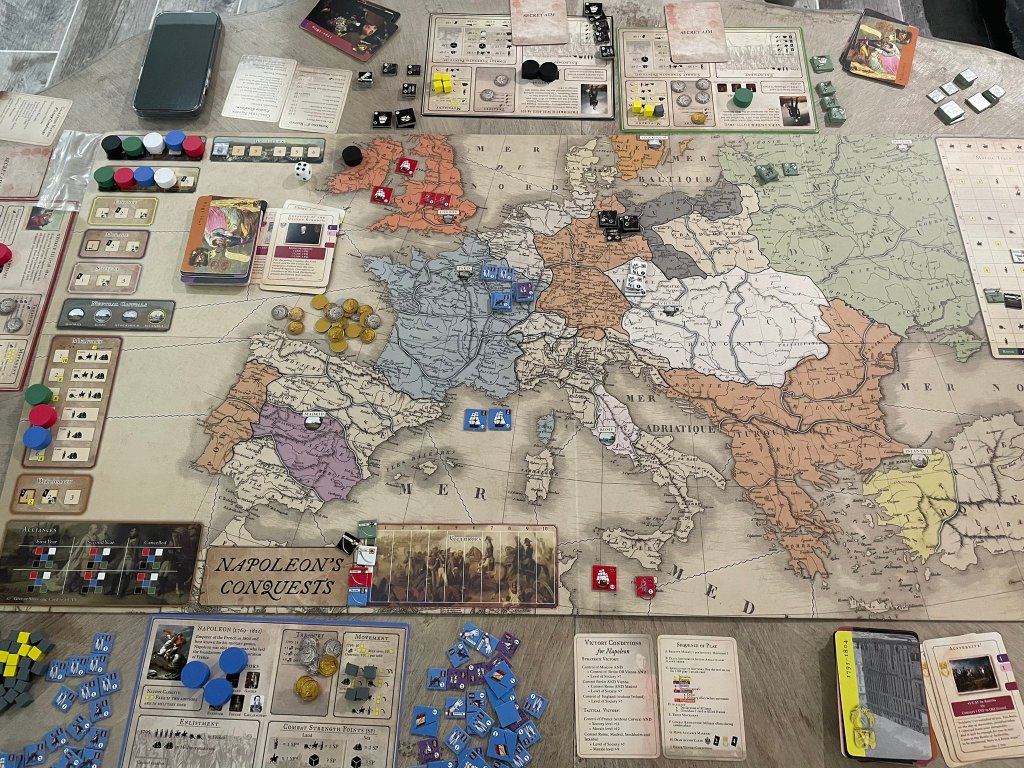
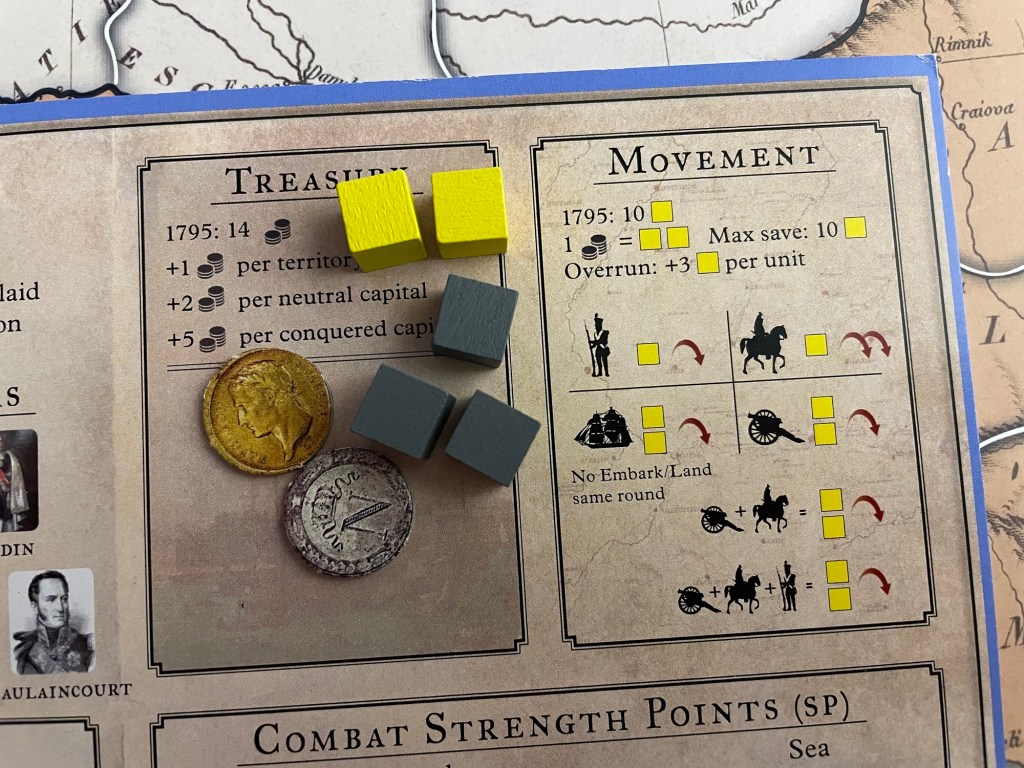
One of the parts about the design that I truly liked was the concept of military and how the player has to focus not only on purchasing new military units but also using some of their funds to purchase Movement Points. Movement Points come in the form of a sort of currency that is tracked using yellow and gray wooden cubes. The gray cubes represent 5 MP while the yellow are a single MP. When the player takes action spaces in the Military Domain, they will have the option of purchasing both Movement Points and military units and must focus on both. This becomes somewhat of a balancing act because if you have too many units on the board and not enough Movement Points to get them where they are needed you have not managed this part of the game well. One other thing that is key about Movement Points is that they are not only used by the attacker as they advance on enemy units but when a defender is forced to retreat as a result of battle, they have to have the Movement Points to move their units or unfortunately they will be run over by the victors and eliminated. This was such a great part of the game and I really appreciate its inclusion.
Production is Beautiful…with Minor Issues
The production on this game was top notch! I will say this for Fellowship of Simulations. They know how to make a good looking game. The art chosen for the cards was fantastic, the symbiology on the board was very clear and eye catching. The use of a period map overlay on the board was a fantastic choice as it really created the illusion that we were all sitting around a war room planning table hashing out our strategy.
While the production was awesome, it was not perfect. The writing and spaces on the board needed to be larger. For example, when you place your Advisor tokens on the board during the worker placement section of the game, the markers are larger than the spaces which leads to you having to remove them to remember what it was that the bonus action or ability was. This should have been improved by using smaller Advisor tokens or by placing the bonus actions above the boxes.
I also felt that the boxes on the left and right sides of the board could have been larger as the board is quite big and these boxes could have been maneuvered around to create an easier to see and use layout. My only other complaint was that the player boards were very small and flimsy as they were a very thin cardboard. Other than that, the production was amazing and I really enjoyed playing the game.
Rules Trouble
My final comment is on the rulebook. And I want to say this first so it is clear but Fellowship of Simulations is a French publisher and the designer is also French. The game was designed, written and most likely played by French gamers and then translated over to English. It wasn’t that the rules were bad, I have seen worse, but they were just not clear sometimes. There was some ambiguity that relied on the 4 of us discussing amongst ourselves and then coming to a conclusion that made the most sense to all parties. And this is not the first time that we have had some issues with the rules in one of their games. We have also played Verdun 1916: Steel Inferno and Wars of Religion and had a similar problem with the rules in these games. My recommendation would be to hire someone who is non-French speaking, but who is obviously fluent in French, to assist in the translation of the rules. It would also be nice if they were a gamer as the nuance is sometimes lacking in the translation.
Well, that is it for my thoughts on Napoléon’s Conquests. I really think that the game here is pretty good and would definitely want to play it again when the chance arises. I definitely think that our 2nd play will be faster, better strategically, as I think that France was aggressive and running away with the game because of a lack of understanding on the part of the other Coalition players, and more enjoyable. I actually really liked this game and look forward to other games from them in the future.
Here is a look at our unboxing video to get a better feel for the size and magnitude of the board and the quality of the components:
https://theplayersaid.com/2023/12/30/unboxing-video-napoleons-conquests-from-fellowship-of-simulations/
We also have shot a first impressions style video but it won’t be out for a few months as we have quite the queue.
-Grant
 The Players' Aid