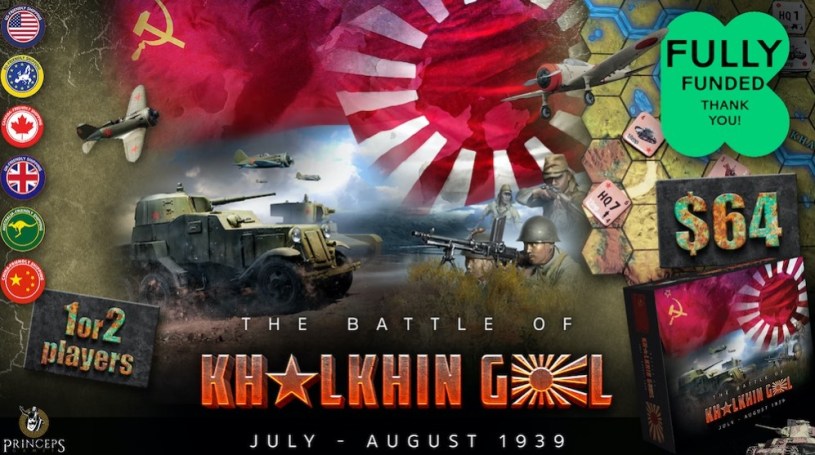
A few years ago, we encountered a new company on the scene called Princeps Games with their first game titled March on the Drina. Since that time, they have had an additional successful Kickstarter campaign for Freezing Inferno: USSR vs. Finland 1939-1940 and now they have their third game going to crowdfunding called The Battle of Khalkhin Gol – July – August 1939 which deals with conflict on the Soviet-Japanese border in the east during the buildup to World War II.
If you are interested in The Battle of Khalkhin Gol – July – August 1939, you can check out the Kickstarter campaign at the following link: https://www.kickstarter.com/projects/princepsgames/the-battle-of-khalkhin-gol
Grant: Vukašin welcome back for another interview and congratulations on your first 2 games March on the Drina and Freezing Inferno being funded and published. What did you learn from those Kickstarter campaigns?
Vukašin: It was a great experience. It showed us that hard work does pay off in the end. People see that you are trying to bring something new to the hobby and they reward the effort. Our goal was to bring some beauty into the wargamer’s world and that is why we tried to be unconventional and offer our backers a choice of a more artistic approach to the wargame hobby. Also, we learned that having your audience is crucial for the success and we are grateful to have built one.
Grant: What historical event does your new game The Battle of Khalkin Gol cover?
Vukašin: The Battle of Khalkhin Gol covers the border clash between Imperial Japan and the USSR at the very dawn of World War II. In 1939, Manchuria was a puppet state of Japan known as Manchukuo, and Mongolia was a communist state allied with the Soviet Union, known as the Mongolian People’s Republic. The conflict was about a disputed territory near the Khalkha River. Eventually, the Soviets won and that battle set the course of Japan’s war plans and shifted the focus from land campaigns to marine warfare. This battle shaped the whole course of World War II in the far east and Pacific.
Grant: Why did you want to design a game on this event in the Russo-Japanese War of 1939?
Vukašin: This conflict is relatively unknown, and there aren’t many games that cover this battlefield. We wanted to bring something fresh to the wargamers hobby, so this historical event was the right choice.
Grant: What was your design goal with the game?
Vukašin: The design pretty much relies on our previous game Freezing Inferno using a similar rule set, so our goal for this one was to make sure that the mechanics fit the historical circumstances. We did add some new things, such as the Air Superiority Phase, river crossings, use of bridges, digging-in, etc. to better reflect the fighting here.
Grant: What type of research did you do to get the details correct? What one must read source would you recommend?
Vukašin: As usual, historical websites, books and articles covering this subject. One was particularly helpful, an article by Amnon Sella titled Khalkhin-Gol – The Forgotten War, which can be found in the Journal of Contemporary History (SAGE, London, Beverly Hills and New Delhi), Vol.18, 1983, 651-687.
Grant: How different are the Japanese units from the Soviet units?
Vukašin: The units for both sides are the same, except the Japanese units have the ability to dig-in and surprise the Soviet units while they move forward to their goal.
Grant: What area does the game board cover?
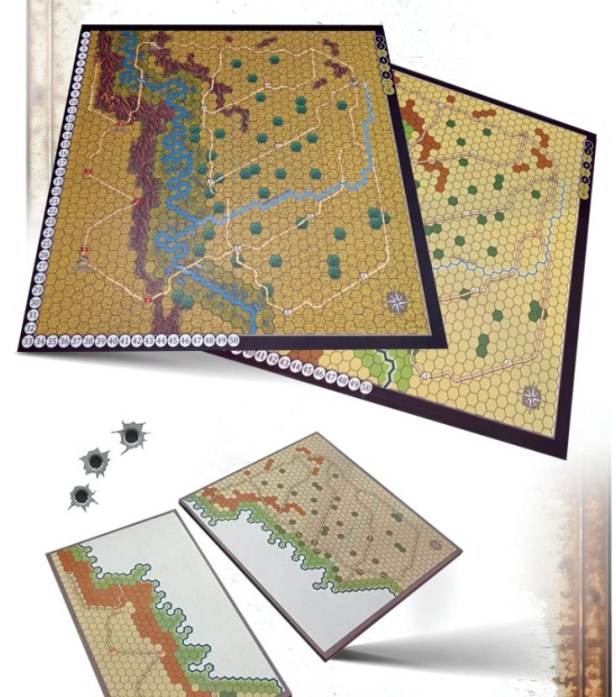
Vukašin: The game board covers the area around both the Khalka and Holsten Rivers, an area covering approximately 50×50 kilometers.
Grant: Who is the artist for the board?
Vukašin: The board has two different offerings for players including an artistic style and a hex focused style. Dušan Božić was the artist for the artistic board, while Nenad Mirković was responsible for the wargaming style board.
Grant: What role does the Attack Modifiers Chart play? What is the makeup of the various modifiers?
Vukašin: Terrain has a different effect on unit’s attack and defense capabilities. You have several types of terrain and since the battle is taking place on a hex where the defender is located, that terrain will determine the modifier which will apply.
Grant: What is the Political Points Chart? How are these earned and what can they be spent for?
Vukašin: Political Points (PP) are a form of currency used in the game. The goal for both players is to capture enemy’s Checkpoints, while maintaining the control of their own. The sum of Checkpoints shows how many PP’s the player will get. Later on, the players use PP’s to bring reinforcements into the game.
Grant: What are Checkpoints?
Vukašin: Checkpoints are hexes on the board with red and yellow flags. The goal of the game is to capture as many of them until the end of round eight, when the game ends. As said before, Checkpoints bring Political Points, which bring reinforcements.
Grant: What are the Key Checkpoints and what locations from history do they represent?
Vukašin: The Soviet Key Checkpoint is Tamsak-Bulak, an air-base in Mongolia which was played a very important role during this conflict. The Japanese Checkpoint is the town of Nomonhan in Manchukuo. This battle is also known as the Nomonhan Incident.
Grant: Why are these locations so important to each side?
Vukašin: If the enemy captures your Key Checkpoint and holds it until their next turn, they will lose the game, no matter what round it is. So, it is very important to be careful and not allow the enemy’s units to go past your defense lines and capture your Key Checkpoint.
Grant: What type of units are available to players? What are there relative differences?
Vukašin: Both players have Infantry, Cavalry, Artillery, Tanks and Generals (Headquarters) available. The units have the same characteristics and there are no differences between them. In addition, players have Bombers, Fighters and AA guns. They are not placed on the board, but are used in a separate minigame at the start of each round.
Grant: How is unit strength represented on the board?
Vukašin: Unit strength is represented by the number of counters. A maximum strength of the unit is 5, so there can be a maximum of 5 counters stacked. Only one unit can occupy one hex, so stacking of counters never goes beyond 5.
Grant: What are the Units with the Star Marker? What purpose do they serve?
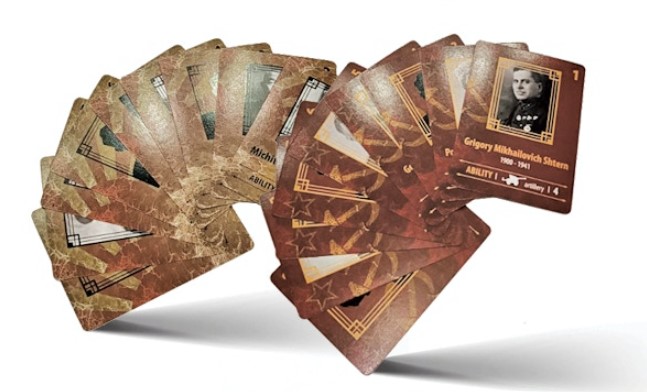
Vukašin: Units with the Star Marker have special attack abilities. Every General is particularly good in commanding a certain type of unit which is stated on their card and their skill is determined by the numbers 2, 3 or 4. The numbers on the card show a minimum result of a die roll for that type of unit and for that General. This applies only to the unit with a Star Marker. In this way, the players can be sure that the unit with the Star Marker can’t go lower than that number while attacking.
Grant: How are Air Units used and how is Air Superiority determined?
Vukašin: Since the battlefield at Khalkhin Gol was approximately 50×50 kilometers, using the air units in the same way as in our previous games would be illogical, due to the fact that the air units have a much larger range than 50 km, hence they would be able to attack the ground units all over the board. In addition, air battles did take place in this conflict, but they were far from being a decisive element.
This is why we decided to create a new system for air battles. At the beginning of a round the players first play a mini-game to decide who has the Air Superiority in that round. The player who has won the Air Superiority has several options.
One thing we noticed while analyzing the feedbacks from wargamers is that people often miss a very important element of this new system and that is the influence of the reinforcements to the game. Most of the people who played the game are used to see the attack modifiers as the most important part of this Air Superiority System, but this is actually wrong. In this game players have an income in every round, which is used to buy reinforcements, so the attack on the enemy’s supply lines, as one of the options for the player with Air Superiority, reduces that income, which leads to less resources for reinforcements, which then leads to less troops on the board. In this way, having the Air Superiority can be crucial for winning the game.
This is all explained in our video here:
Grant: How are Air Battle Cards used? Can you show us a few examples of these cards?
Vukašin: Air Battle Cards (ABC) are used in the Air Superiority Phase. Both players have 9 Air Battle Cards and they use these cards instead of rolling a die. In this way, luck has no part and every decision is made by the players. It all depends on how well you know your opponent and what strategy you want to implement.
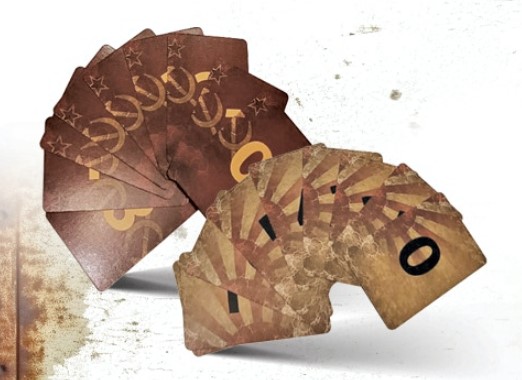
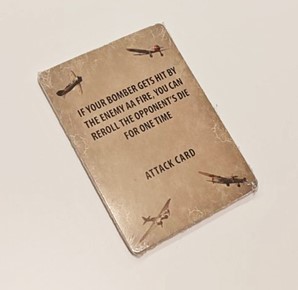
Grant: What are Air Strike Cards and how are they used? Can you show us a few examples of these cards?
Vukašin: Air Strike Cards are used after it is clear which player has the Air Superiority in that Round. Each player has 7 Air Strike Cards at their disposal. During the attack on the enemy’s Air Base or enemy supply lines players can play ONLY ONE Air Strike Card per round to affect the outcome of the battle.
Grant: How does the Battle process work?
Vukašin: The battle takes place on the hex where the attacked unit is located. Only one unit can attack one enemy unit. The battle is always 1 unit vs. 1 unit.
First, The Total Attack Value (TAV) of the attacking unit and the Total Defense Value (TDV) of the defending unit are calculated. Units have their values in the attack and defense, so when you add their value to their strength (number of counters) you get TAV and TDV. TAV:TDV are put into a ratio (for example, 7:7, 8:9 or 10:8). The players look at the corresponding Column on the CRT. The Attacker rolls a die. Terrain Attack Modifiers and The Calendar Attack Modifiers (if applicable) are applied. The players look at the corresponding Row on the CRT and apply the result.
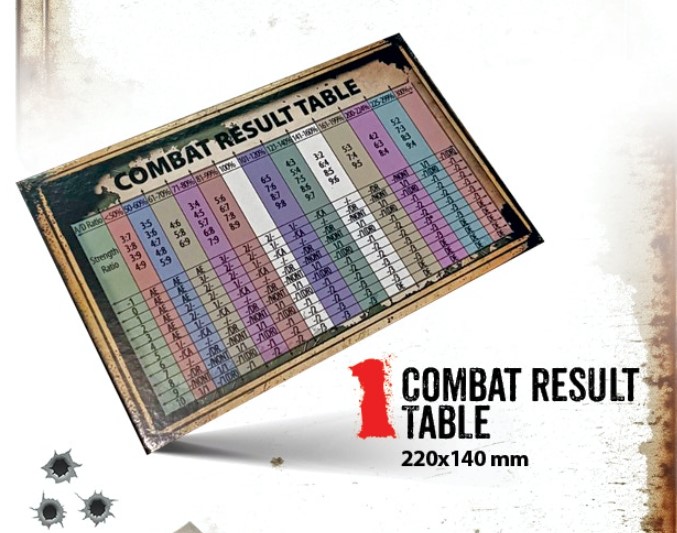
Grant: What is the makeup of the Combat Results Table?
Vukašin: We wanted to make a simple CRT, which is easy to read and easy to implement. Besides the classic system, here you can find unit ratios pre-calculated, so the players don’t have to do math and lose time. In addition, there are a couple of results that are taken from our previous game Freezing Inferno and they fit here nicely.
Grant: What are the Generals used for? What type of skills do they have?
Vukašin: Each player has 9 Generals at their disposal. Every General is particularly good in commanding a certain type of unit which is stated on their card and their skill is determined by the numbers 2, 3 or 4.
The numbers on the card show a minimum result of a die roll for that type of unit and for that General. For example, if an Infantry unit is in the supply area of the General who is particularly good in commanding Infantry and has a skill of 4 that means that when that Infantry unit is attacking, every die roll result which is lower than 4 will automatically be counted as a 4.
In that way, depending on their skill in commanding certain type of attacking units, the Generals can affect the outcome of the battle.
Furthermore, the Generals bring supply to the troops, so units have to be in a 6 hexes radius in order to be in a supply or to receive reinforcements. This is why it is very important to protect your General.
Grant: How is Weather determined and what effect to the game does it have?
Vukašin: Weather conditions are determined by using a D12 die together with the Weather Chart. Players roll a die at the beginning of a round to determine what kind of weather will be in that round. The weather can affect the movement and attack ability of the units.
Grant: What are Tactical Improvements?
Vukašin: The players have two Tactical Improvements available, which are indicated on the Player’s Cards: ESPIONAGE (The player can reroll their or their opponent’s die if not satisfied with the result) and DECEPTION (when attacked, the defending player can use the Deception Token and withdraw the unit before the battle).
Grant: What is the general Sequence of Play?
Vukašin: The players decide on their strategy and place the units on the board using the mini-maps (which allows for the hidden setup option). Players take turns trying to complete their goals. After all units of one player have finished their move, the next player does the same. Players can bring in reinforcements in certain rounds of the game, which is determined by the Calendar. At the end of round 8 the game is over and the winner is determined.
Grant: Who has the tougher time in achieving victory?
Vukašin: I would say that the Soviet player is in slightly tougher position since they are the one who needs to push forward and capture Checkpoints. But, it all depends on the setup and the strategy of the players.
Grant: What are you most pleased about with the design?
Vukašin: I am very satisfied how the river blended in the design. It is exactly what we were aiming for, since this is where the battle took place. Also, using the bridges for crossing the river gave the players a variety of options and build up the replayability of the game. I think this is a major step forward from our last game.
Grant: What has been the response of playtesters?
Vukašin: Playtesters have found the game interesting, easy to setup and very intense. The rivers were a big plus for them, but also the feeling they had is that both sides are more/less offensive at the same level. Usually one player is offensive, while the other is defensive, but here it is not the case. Both players can play offensively and still win the game.
Grant: What stretch goals are included in the Kickstarter campaign?
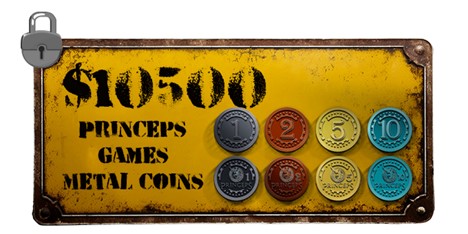
Vukašin: Right now, we have a couple of stretch goals unlocked and they bring more quality to the components of the game. Our next stretch goal is something I believe a lot of gamers will find interesting and that is Princeps Games Coins! We hope that we will unlock it soon and then we will offer it as a separate pledge, too.
Thank you for your time in answering our questions Vukašin. I can feel your passion for this game and for the history of the battle. I wish you good luck on this campaign and hope to see people playing and enjoying this game on an under represented aspect of World War II in the near future.
If you are interested in The Battle of Khalkhin Gol – July – August 1939, you can check out the Kickstarter campaign at the following link: https://www.kickstarter.com/projects/princepsgames/the-battle-of-khalkhin-gol
-Grant
 The Players' Aid