
After having met Raymond Weiss in person a few years ago at WBC and after having done a few initial interviews with him for the blog (Rostov ’41: Fritz on the Don from Multi-Man Publishing, Imperial Bayonets: Liberty for Lombardy 1859 and Destroy All Monsters Operational Series (DAMOS) from CSL), we have been impressed with the success to date with his new publishing company Conflict Simulations Limited and his very interesting design approach. Recently we reached out to him to get a look inside his new 2022: Urkaine game that is being offered on pre-order.
If you are interested in 2022: Ukraine, you can pre-order a copy for $74.99 from the Conflict Simulations website at the following link: https://www.consimsltd.com/products/2022-ukraine-pre-order

Grant: Great to have you back on the blog Ray. What is the focus of your new upcoming game 2022: Ukraine?
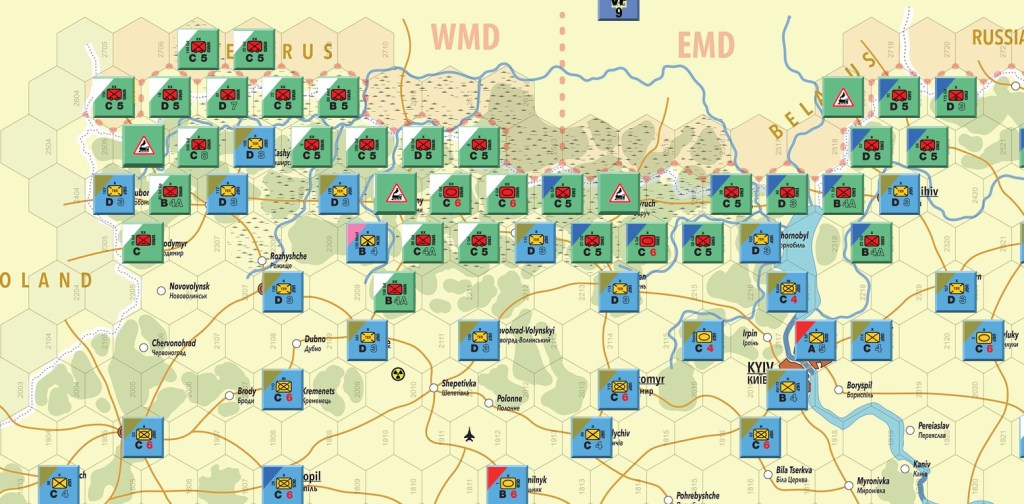
Ray: Always great to talk with you guys and thank you for your interest in my designs. The main focus of 2022: Ukraine is the initial invasion and first year of the current and ongoing Russo-Ukrainian War. The design looks at the conflict purely at an operational level.
Grant: What are your thoughts on a game on a conflict being so recent and still in the news? What would you say to those who are concerned about this design?
Ray: I write a lot about this topic in the design notes and I think I express myself best there so I’ll briefly quote from it to give responses to your questions:
“…as a bleeding-heart millennial I would normally empathize with people who said that doing a game on an ongoing topic was insensitive. After giving the topic a considerable amount of thought and debate amongst a trusted group of designers/developers, I determined that this ultimately is kind of an absurd notion given that 90% of the hobby deals with the holocaust, arguably the most infamous instance of industrialized genocide in history, as a backdrop while players move black counters with skulls around.
While I don’t begrudge anyone for enjoying WWII games, the idea that there is an expiration date on
conflict after which it becomes okay to “game” seems ultimately absurd to me. I do believe most of these people are well-intentioned and truly believe that it’s not okay to do a game on Ukraine since the war has dragged on for another year. On a purely moral level, I fail to see any serious failing in producing a game on the subject so long as you also use it as an opportunity to bring awareness and/or contribute in some other way, which I’ve always sought to do with this game. By this theory it is no less grating to the survivors of the holocaust who are still alive to see the battles for their freedom reduced to merely a “game” in this context, though I think most wargamers know better than this. Even Mark Herman has announced he is now working on a Ukraine game as well that deals with more of the granular and interpersonal aspects like hostages.”
Grant: What is your overall design goal with the game?
Ray: I hope ultimately the game brings some more awareness to the conflict, elsewhere in the design notes I talk about my bias as a designer being admittedly fairly pro-western and there are some notes about confirmed war crimes by the GRU. I’ve also pledged to donate 15% of the sales upon release to Tip of the Spear, which is an organization that works in mine removal on location in Ukraine.
Grant: What do you feel is most important to model from the conflict?
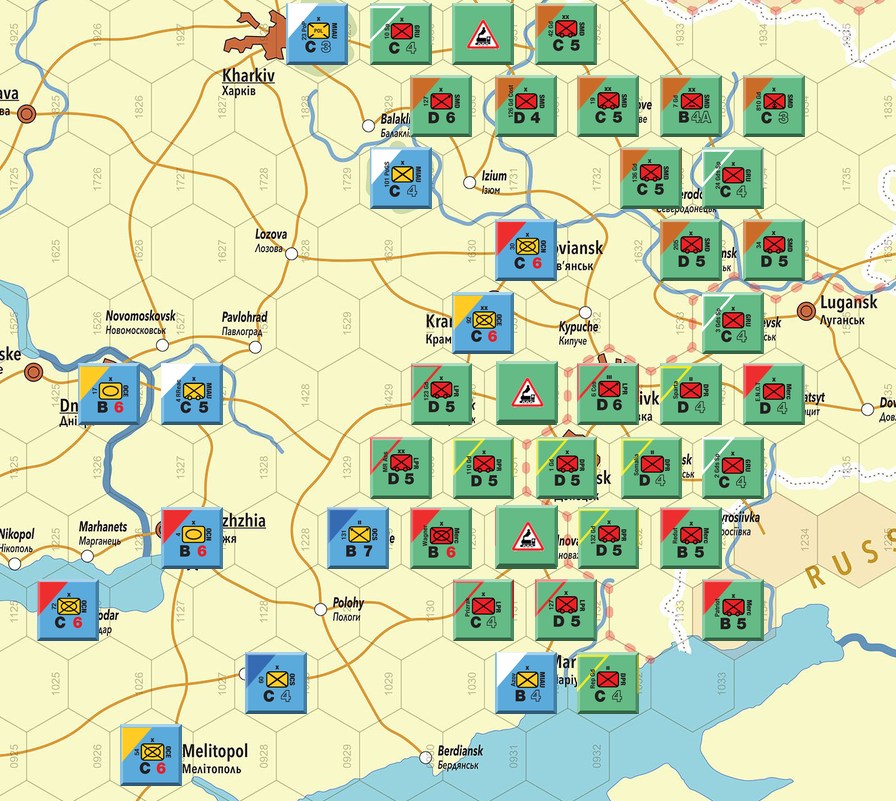
Ray: Tough question as there are numerous important aspects that I’ve tried to bake into mechanics. One of the most significant mechanics is Russian dependencies on railways and railheads, only units occupying or adjacent to a railhead are able to trace a Line of Communications (LOC) and in the context of the Procedural Combat Series, without a LOC they will be unable to activate on the next turn. This accurately models how the Russian advance was hampered by their lack of fuel trucks and constant partisan meddling. On the flip side, Russian units have an easier time recovering from routed status (eliminated) due to their inherent advantages in manpower. One essential aspect I did not want to shy away from was Russian atrocities along with the possibility of a nuclear catastrophe, special rules and events are in place for both. The more aggressive the Russian player is, the more likely the west will be to send over things like Patriot missiles, HIMARS systems, etc. You probably get the idea by now.
Grant: Where did you get information from to construct your OOB?
Ray: Since it primarily focuses on 2022, mostly pre-war Orders of Battle along with open sourced information which is about the best available right now. Another help is that my artist for this game (Ilya Kudriyashov) is fairly knowledgeable about the situation and has been able to correct a few incorrect assumptions I made.
Grant: The game is a Procedural Combat Series game. What are the hallmarks of this system?
Ray: The system focuses on unpredictability, I’m not sure if you guys remember but you played the very first game in the series 1950: Korea – The Forgotten War (oh yes we remember and truly enjoyed that game!) years and years ago when I first started out. Since then it has undergone numerous changes to tighten up the core gameplay loop while retaining the same element of managing unpredictability. A key hallmark of the system is that the game is more “Go” inspired than other wargames in that players go back and forth activating units instead of moving all of your units at once followed by your opponent. This creates a unique tension in the game where you can of course have a plan but the enemy will always have an opportunity to have a say in that plan.
Grant: How does the conflict fit into the Procedural Combat Series system?
Ray: Only so much in that it covers post WWII combat, its a bit similar to 1995, which is an earlier game in the Procedural Combat Series but I’ve been focused on trying to keep this one balanced while remaining true to history.
Grant: How has your own bias affected your design?
Ray: Constantly, but it’s something I try to be aware of and address. Whereas Russian units have numerous supply issues and other loathsome mechanics, they in turn benefit from a much larger pool of forces, air assets, naval assets, missile assets, and a better chance of recovering forces. Unlike Ukraine, they also have a chance of an Automatic Victory by occupying Kiev and making a roll to capture Zelensky.
Grant: What is the game’s scale and force structure of units?
Ray: Most units are brigades with a few smaller units, including just a handful of divisions. Each turn is 1 month and hexes are around 24 miles.
Grant: What is the anatomy of the counters?
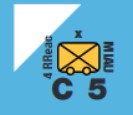
Ray: Units feature a Unit Quality Rating (UQR) to their left and a Movement allowance to their right. Their army ID is located to the right and color coded on the upper left. The frontside of a unit is it’s Fresh side, and the backside is it’s Static side. Static units cannot activate until the next turn (and only if they have an LOC at the end of the current turn).
Grant: How are Airmobile Infantry modeled? How are Paratroopers different?
Ray: This is something I actually ended up consolidating in the rules since you first saw them, nearly all the Airmobile units are Air Assault units so I treat them all the same way now. They are basically able to move around the battlefield freely though they get subject to both air patrols and SAM fire.
Grant: How does combat work? How are the Combat Chits used? What is the makeup of these chits?
Ray: The active player first chooses between a Meeting Engagement and Prepared Attack. MP’s get spent for Meeting Engagements and Prepared Attacks can only be done when adjacent. Players draw Combat Chits and cross reference them with the unit’s UQR to determine their combat strength. Then a number of modifiers are considered such as supporting units, air support or specialized units/assets. Finally, both players roll dice and a differential is produced, the differential is used to determine the result of combat as Loss Points are generated, anywhere from a ratio of 1:1 to 1:3. Kind of hard to explain briefly, but it rewards careful planning as the more modifiers you are able to secure, the more confident you can be in a result.
Grant: What is the general Sequence of Play?
Ray: The Sequence of Play is fairly standard. Reinforcements and recovery happens first followed by determination of initiative, which is listed on the Game Turn Track. LOC’s are checked at the end of the turn as part of the Cleanup Phase.

Grant: How is Airpower modeled? What different air units are available to both sides?
Ray: Airpower is heavily abstracted, with a focus on air missions. Players assign either fighters or bombers to missions like interdiction, ground support, suppression, strategic bombing or patrols. Players choose these missions during the Air Commitment Phase, some of them get played out right then, and the rest of them come into play during the Action Phase. There is a chance the west will send F-16’s which are classified as fighters.
Grant: How are Air Units used to intercept other air units? How does Air-to-Air Combat work?
Ray: Fighters assigned to the Patrol Box have the option to intercept enemy air missions, if any escorts are present Air-to-Air Combat occurs, and then if units are damaged they become spent and unable to complete their mission. Air-to-Air Combat is solved with a simple Effectiveness Check where the player must roll equal to or under the aircraft’s Effectiveness Rating. The player with the initiative receives a -1 DRM to these rolls and air units which are successful have a chance to remain “on call” and assigned back to the same or a different air mission.
Grant: What is the role of Strategic Bombing?
Ray: Strategic Bombing refers to air strikes made against infrastructure, communications, and other
strategic assets that for play purposes are considered off-map. The active player selects all G air units in the Strategic Bombing Box and decides if any F air units from the Patrol/Escort Box will accompany them. The opposing player then decides whether to intercept with F air units from the Patrol/Escort Box. Once any Air-to-Air Combat is completed then if any G air units remain in flight they each attempt an EC. If there are one or more successes the bombing player earns 1 VP (i.e. Russian bombing would cause VP to increase by 1, Ukrainian bombing would cause VP to fall by 1). The G air units then each check for SAM fire and each remaining air unit that participated checks On-Call status.
Very simply, the purpose of Strategic Bombing is to allow players to attack VP’s pushing the marker one way or the other towards a victory.
Grant: How does Combat LOC Interdiction work? What is its strategic purpose?
Ray: One of the options units have when absorbing losses is to spend VP’s among other units assigned to interdiction and which are successful prevent units from absorbing losses in this way.
Grant: What area does the board cover? What difficulties does the terrain present?
Ray: The board covers the entire country. Most difficult terrain is the swamp coming in from the north from Belarus and the Pripyat bogs, it is easy to see why Russian forces going that way got so bogged down.
Grant: What types of artillery or ground support do players have access to?
Ray: Artillery is not specifically represented given it’s at the brigade level but there are special Artillery units, such as HIMARS, Cruise Missiles and Patriot Missiles which can give benefits towards UQR ratings in combat or SAM fires.
Grant: What special rules are included and why?
Ray: Many hahah, too many to list all here, and I think I’ve mentioned several of them in the process of answering these questions, there are some little things though like when Ukraine has the intiative, all foot infantry units get a bonus +2 modifier against mechanized Russian units.
Grant: How is victory achieved?
Ray: There is one automatic victory condition I mentioned earlier but otherwise the game ends when the VP marker is pushed all the way to one players side or another or at the end of the game, the VP marker is assessed for the result.
Grant: What are you most pleased about with the outcome of the design?
Ray: That’s hard for me to answer, but I’m glad that I was able to update and improve a system I designed 5 years ago when I first started CSL. I am quite happy with the design notes and I guess I will be happy with the game so long as people enjoy or get something useful out of it.
Grant: What type of experience does the game create for players?
Ray: The Procedural Combat Series is a unique and challenging system to master and its structure allows for infinite replayability. Players are guaranteed to never play the same game twice.
Grant: What other designs are you currently working on?
Ray: Oh my god so many haha. I just released 490 BC: Marathon and Prigozhin’s March of Justice (title is a bit sarcastic) and I am really happy to finally get those out. My top priority right now is DAMOS North Africa which I’ve decided to combine into a single game as opposed to three separate games like Barbarossa. I’ve drafted the rules and rewrote the core DAMOS rules as well, currently waiting on counter art so a vassal module can be made up. Additionally I’ve begun work on The Earth as their Memorial, our game on the Peloponnesian War. Recently finished the Allied Order of Battle for The War Against Russia, our game on the Crimean War and Danube Theater, Imperial Bayonets Solferino along with a rewrite of the core rules as well as a number of smaller minigame projects I’ve since been inspired to do recently (Prigozhin being the first of those).
Thanks again for the opportunity to talk about the game guys, I appreciate it!

Ray thanks for your time in answering our questions about 2022: Ukraine. I am glad that designers like you are willing to take a look at some of these current events to make sure we learn something from them. You know that old saying, “Those who cannot remember the past are condemned to repeat it.” I for one am looking forward to this one, partly because of the subject but also because we have enjoyed the Procedural Combat Series in the past.
If you are interested in 2022: Ukraine, you can pre-order a copy for $74.99 from the Conflict Simulations website at the following link: https://www.consimsltd.com/products/2022-ukraine-pre-order
-Grant
 The Players' Aid
Love the graphics design. Post the rules.
LikeLike