
We all love Twilight Struggle….and if you say you don’t, you really do but just want to be different or are a contrarian! The game is phenomenal and has done very well for GMT Games with 8 Printings as well as the Turn Zero Expansion and now a series of smaller geographically focused spin off games starting with Twilight Struggle: Red Sea – Conflict in the Horn of Africa. Twilight Struggle: Red Sea deals with just two regions located in the Horn of Africa including Africa and the Middle East. The game uses the familiar Twilight Struggle formula of Cards with both Events and Operations Points that can be used by players to perform Coups, do Realignment Rolls or place Influence in an effort to gain control of the most Countries in the Regions to score Victory Points and win the game. The game is fast, furious and only lasts 2 hands of cards (unless you choose to play the special 3 Turn variant) so there isn’t a lot of time to mess around and players must be focused on what they are trying to accomplish. The best thing about the game is that it plays in 45 minutes as compared to 3-4 hours for Twilight Struggle.
In this series of Action Points, we will take a look at the board and discuss the two Regions depicted, examine the various Tracks, including the Action Round Track, DEFCON Status Track, Turn Record Track, Victory Point Track, Required Military Operations Track and Space Race Track and also briefly discuss the new Strategic Sea Lanes Box and the addition of some handy reminders for how various Operations work on the board, examine what is new in this smaller focused addition to the series including the Strategic Sea Lanes Box, Flashpoint Countries and the updated Space Race Track, examine examples of new cards for the Soviets and for the Americans, review the Scoring Cards and how they work and provide our thoughts on this new format and implementation of a fan favorite system.
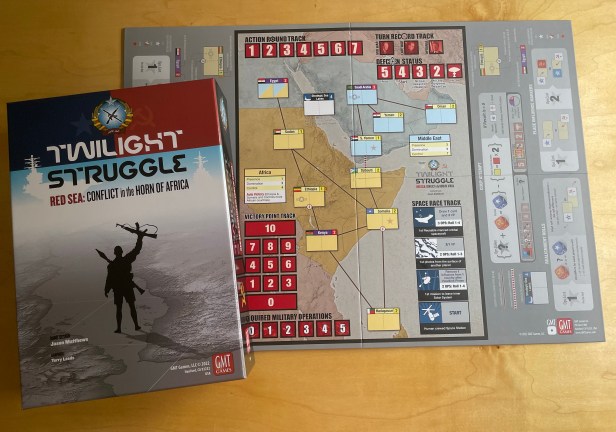
Game Board
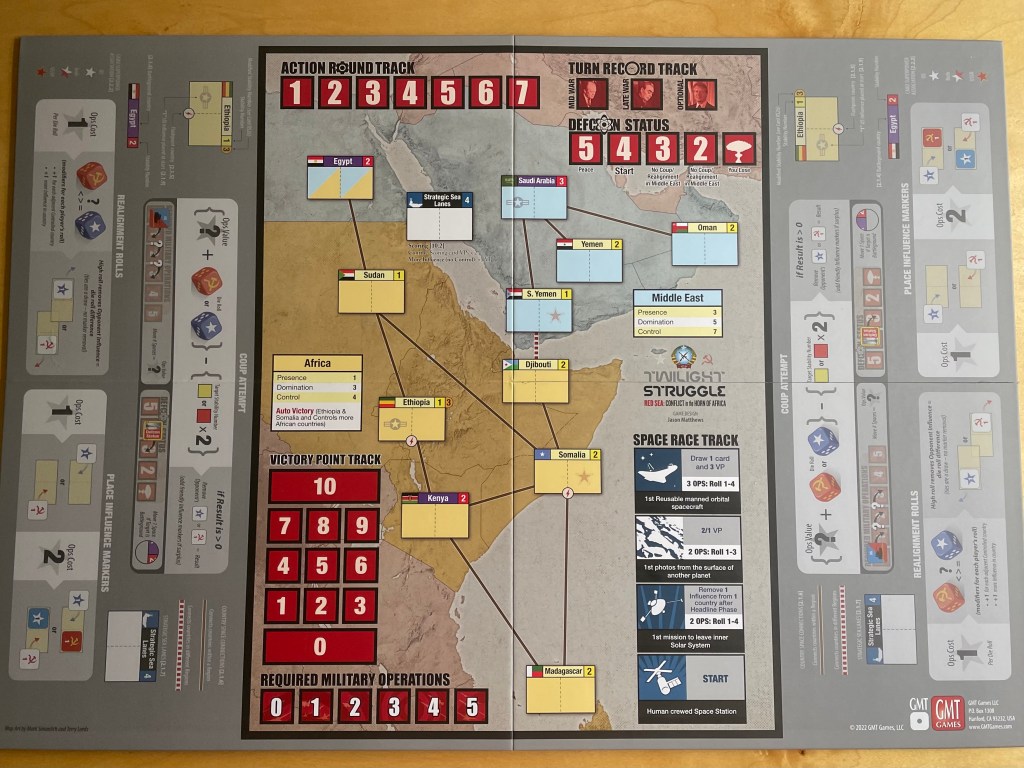
The Game Board for Twilight Struggle: Red Sea – Conflict in the Horn of Africa is much smaller than the board used for Twilight Struggle as it only focuses on two Regions including reduced portions of both Africa and the Middle East and contains a total of 11 Countries and one new Location Type in the Strategic Sea Lanes Box. Africa contains just 7 Countries while the Middle East contains only 5 Countries. As you can see, Egypt is included as a part of both Regions as shown by each Influence Box being half light blue and half tan. When each of the Regions score during the game, Egypt is counted in both Regions.
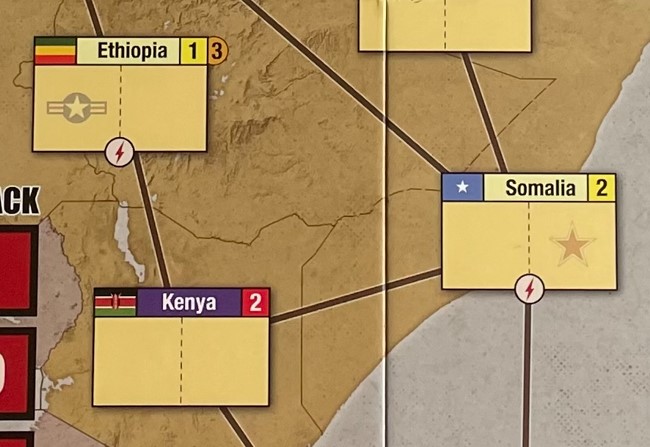
Regions and Countries
Africa contains 7 Countries including Egypt as mentioned, Sudan, Ethiopia, Djibouti, Kenya, Somalia and Madagascar. You will notice that Egypt and Kenya is a Battleground Country as identified by the purple banner. This is a change from Twilight Struggle, which didn’t include Kenya as a Battleground. You will also notice a new symbol appears in both Ethiopia and Somalia. This red lightning bolt icon indicates that these 2 Countries are Flashpoints, and are distinct from Battlegrounds. The Ogaden War is a central focus of Twilight Struggle: Red Sea and both Ethiopia and Somalia work differently than in Twilight Struggle. We will cover this more in Action Point 2.
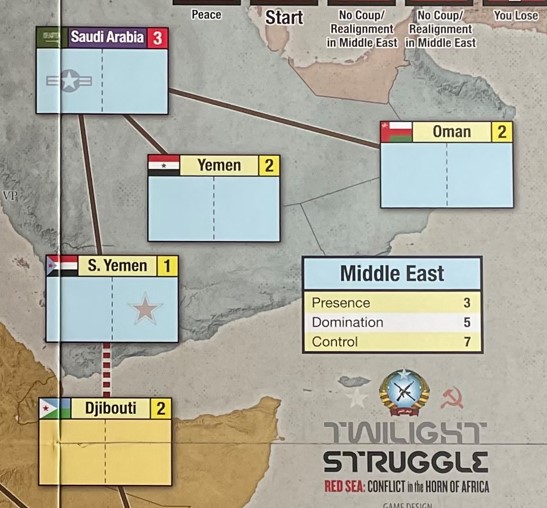
The Middle East contains just 5 Countries including Egypt, Saudi Arabia, S. Yemen, Yemen and Oman. Battlegrounds include both Egypt and Saudi Arabia.
One other note about the Countries is that you will notice that there are symbols of each Nation involved in the titanic struggle of the Cold War including the United States and USSR found in some of the Countries. These represent where starting Influence is placed at the outset and is a nice addition to aid in setup.
Connecting Lines
You will also notice that there area 2 different types of connecting lines found on the board, including brown and red lines. Brown lines connect Countries within a Region while the lone red dashed line connects Countries located in different Regions such as with S. Yemen and Djibouti. A Country is considered adjacent to all other countries to which it is connected. This concept is important for various functions in the game such as Coup and Realignment Rolls and the placing of Influence.
Strategic Sea Lanes
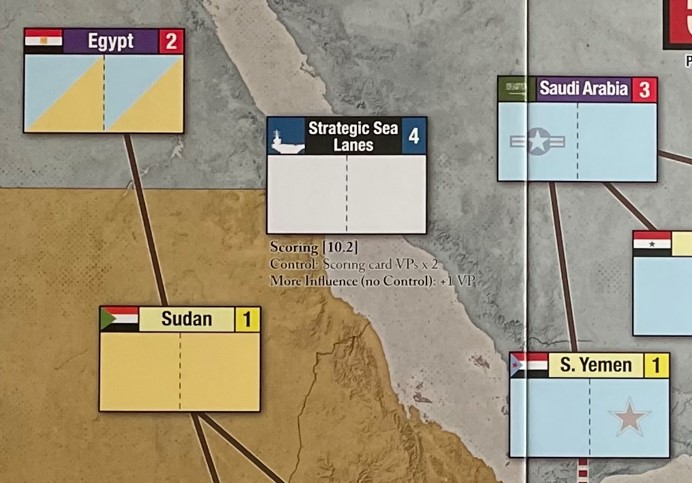
Strategic Sea Lanes are a very interesting new addition to the game that changes how scoring is completed. The Strategic Sea Lanes Box is a space found on the board but it does not represent a specific physical location. It is not a Country and is not connected to any other Countries. It has special rules for Influence Placement and Scoring. Players may also never conduct Coup attempts or Realignments in this space. We will discuss this further in Action Point 2.
Tracks
Just as is the case in Twilight Struggle, the Game Board contains many Tracks that aid in tracking very important information to aid in the proper play of the game. These Tracks include the Action Round Track, DEFCON Status Track, Turn Record Track, Victory Point Track, Required Military Operations Track and Space Race Track.
Action Round Track
There are 7 Action Rounds contained in each turn of Twilight Struggle: Red Sea. Players are dealt 9 cards at the start of each turn and one card is used for the Headline Phase leaving 8 cards in the player’s hand. Players take turns playing cards, one per Action Round, which means that normally players will play 7 cards and have 1 card left in their hand. This left over card is referred to as a “held card” and may be played in following rounds. If a held card is carried over, the player will receive 1 less card from the deck in the following turn. The same as in Twilight Struggle, Scoring Cards may never be held and will result in a loss if held. These have to be played and is the heart of the game as players are battling for control of Countries to Dominate and Control Regions. The USSR player always plays first subject to Events that might have been played during the Headline Phase changing this. Actions required by a card are then resolved before the next player gets their Action Round and can play a card. The player whose Action Round is underway is referred to as the Phasing Player.
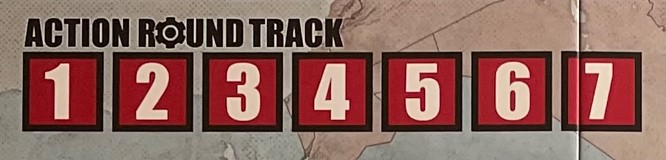
The Action Round Track just keeps track of whose play it is and what card each player is on. Nothing fancy but this is an aid in keeping things straights as sometimes cards require the play of a 2nd card along with it and it is easy to lose your place.
DEFCON Status Track and Turn Record Track
One of the most iconic things about the Cold War is the DEFCON Status and in Twilight Struggle: Red Sea, the same as in Twilight Struggle, players can lose the game if they cause nuclear war with the play of a card that forces a degrading of DEFCON to 1. The DEFCON Status Track goes from 5 to 1, with 5 being Peace and the 1 position, represented by a mushroom cloud, means you lose the game. The game starts in the 4 position and goes from their. The DEFCON Status Track is affected by the play of certain Event Cards and by Coup Attempts in Battleground Countries. The cool thing about the DEFCON Status Track is that below each space is a reminder of the various prohibitions on actions that the players can take. Under both spaces 3 and 2, there can be no Coup/Realignment in the Middle East.
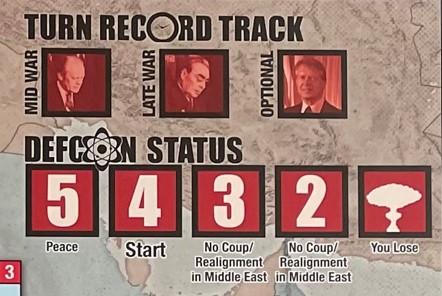
Above the DEFCON Status Track is the Turn Record Track which simply tracks what round of the game the players are in. The start of the game is in the Mid War and then during Turn 2 it enters the Late War. There is an optional rule where players can play 3 hands, rather than the normal game of just 2 hands of cards. This is marked with Optional.
Victory Point Track
The object of the game is to score more Victory Points than your opponent. Players will earn Victory Points by Controlling Countries when a Scoring Card is played or sometimes through playing certain Events that grant Victory Points if certain conditions are met. Each Region has its own associated Scoring Card, which when played will grant players Victory Points depending on how much Influence they have in the Region when it is played.
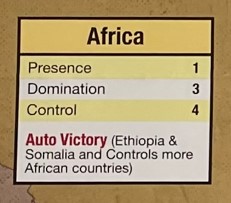
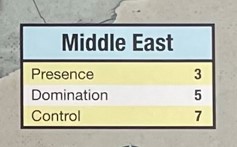
The Regions score a bit differently but also use the same 3 categories as in Twilight Struggle including Presence, Domination and Control. You will notice from the pictures above that Africa scores 1 VP for Presence, 3 VP for Domination or 4 VP for Control in the 3 Scoring Categories while the Middle East Scores 3, 5 and 7 VP respectively. This difference is key and must be remembered by players.
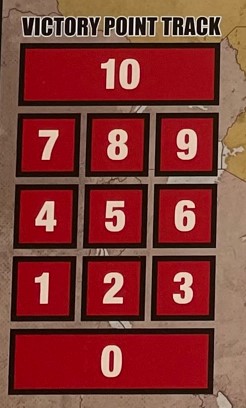
The Victory Point Track is a pendulum which goes from 0 to 10 and when Scoring happens, the Victory Point marker is moved either up or down depending on who has the lead in VP’s. For example, if a card is played at the outset of the game that grants the United States player 2 VP, the VP Marker will be flipped over showing the United States side and move up the Victory Point Track by 2 spaces coming to rest in the 2 space. If on a later card, the Soviet player gains 1 VP from an Event, that marker will be moved back toward 0 by 1 space coming to rest in the 1 VP space. This happens each time VP are scored and can see the VP Marker flip back and forth a few times over the course of a game, especially during the early game as it starts in the 0 space. At the end of the game, the player in the lead will win.
Required Military Operations Track
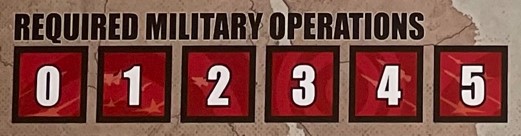
Remembering that this game is a simulation of the events of the Cold War, players are required to perform various clandestine and some overt Military Operations each turn to show strength and effect the World Order or be penalized Victory Points. The Required Military Operations Track is a reminder of where players sit with this aspect during each Turn. The number of Required Military Operations is equal to the current DEFCON Status. If players carry out insufficient Military Operations at the end of a Turn, their opponent will gain 1 VP per unplayed Military Operations point. If both players are penalized Victory Points, the net total should be implemented on the Victory Point Track. Coup Attempts and War Events will count as Military Operations while also possibly reducing the DEFCON Status while Realignment Rolls and free Coup Attempts granted by Events do not.
Space Race Track

The final aspect of the Game Board we will take a look at is the Space Race Track. Twilight Struggle: Red Sea has a bit of a different Space Race Track and players have to be aware of this important track as it is a means of getting rid of a powerful opponent Event Card without having to suffer the effects when the Event goes off. The Space Race Track has a marker for each superpower and a card can discarded with a minimum amount of Operations Points to attempt to move to the next box on the track. To do so, the player will discard a card with an Operations Value equal to or greater than the number shown on the box into which they want to advance. The player then rolls their custom 6-sided die and compares their result to the target number. If the number falls within the range listed below the target box, the player can move their marker to the new box. This action can only be taken once per Turn.
Advancing on the Space Race Track may result in the player scoring Victory Points, gaining a Special Ability, or even both. One box on the Space Race track is marked with two numbers separated by a slash (2/1). This should be familiar to players of Twilight Struggle as it means that the first player to reach this box gains the left VP value with the 2nd player achieving that box receives the lesser right hand VP value.
Player Aid Sections
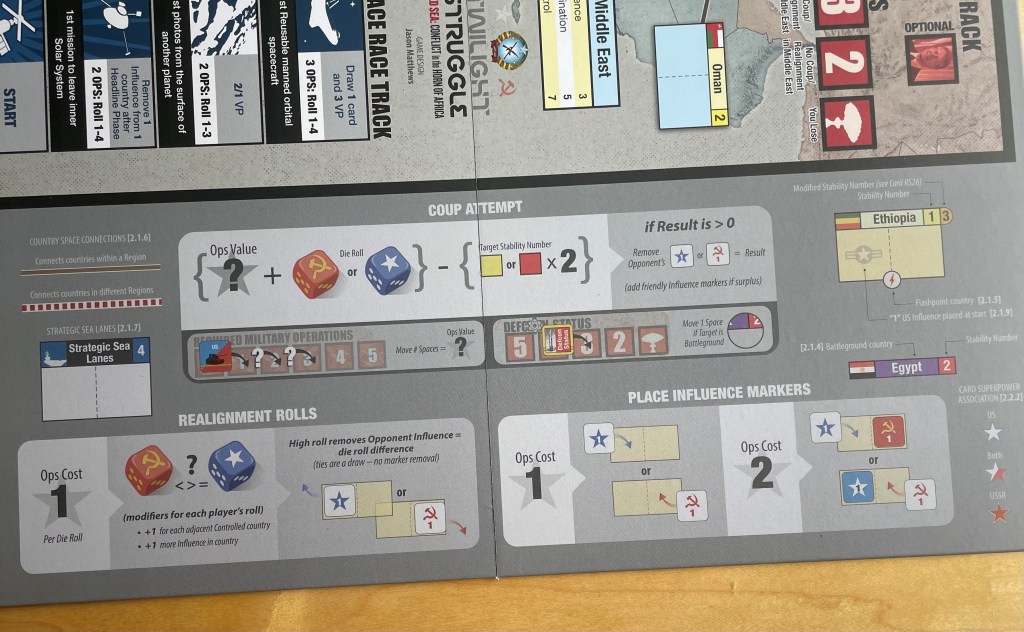
One new addition to the game was the inclusion of Player Aid Sections found on the board for easy reference. These are found on each side of the board for easy reference and give a step by step process of how to do Coup Attempts, Realignment Rolls and how to place Influence on the board. Very well done graphically and we found these very helpful to remind us of the rules for these important Operations.
I hope you have enjoyed my overview of the Game Board along with some of the new mechanics found in the game. I am very pleased with how this game came out and found it a total joy to play. A familiar game and system, that we have played well over 20+ times, truly feels fresh and interesting and absolutely is worthy of being placed on the same level as the original Twilight Struggle. This game is not just a money grab or an expansion to bilk us gamers, but a new and fresh experience that plays fast and has the same palpable tension from the original. Well done Mr. Matthews! Well done!
In Action Point 2, we will examine in greater detail what is new in this smaller focused addition to the series including the Strategic Sea Lanes Box, Flashpoint Countries and the updated Space Race Track.
-Grant
 The Players' Aid
Looking forward to these action points, as I own and played one game of TS: RS, which ended with an auto-win for my opponent in turn one! LOL
I just purchased a 2016 copy of TS (which I have never played), so my gaming addiction shall continue.
BTW, you looked good on the Monthly Debrief last night — glad you are better. Cheers!
LikeLiked by 2 people
Thanks James. TS Red Sea is a very good addition to the family. Plays in 45 minutes VS 4 hours for TS and creates the same tension. It also is not just a rebrand but has some new and interesting elements. I think you’ll love TS as well.
LikeLiked by 1 person