
A new volume in the COIN Series is always a great announcement. I was really interested when Volume VX A Fading Star: Insurgency and Piracy in Somalia was announced as it dealt with a part of the world that had seen several periods of conflict and was the subject of a very interesting time for the UN and United States forces in 1993 as they dealt with Mohamed Farrah Aidid in Mogadishu. Currently, Somalia is the home of the Al-Shabaab terrorist group and I am interested in learning about the state of things there. We reached out to the designer Yann de Villeneueve and inquired about him doing an interview with us for the blog. He was more than interested and I appreciate his effort in bringing this information to our readers.
*Please keep in mind that the artwork and layout of the components used in this interview, including cards and the board are not yet finalized and are only for playtest purposes at this point. Also, as this game is still in development, rule details may still change prior to publication.

Grant: First off Yann, please tell us a little about yourself. What are your hobbies? What’s your day job?
Yann: Hello to all TPA’s readers! I’m a Frenchman, just into my thirties, with a past in the French Air Force, focusing on geomatics and intelligence analysis. I’ve been involved in counter-terrorism and piracy operations, experiences which fueled my interest in military and political history. Now I work in the export sector. I have a soft spot for board games, role-playing, studying international relations, and enjoying a good beer. And I love it when I can mix these interests together!
Grant: What motivated you to break into game design? What have you enjoyed most about the experience thus far?
Yann: I studied computer science in college and originally aspired to work in video game design before my military career took off. I enjoyed dabbling in game mods, creating RPG one-shots, and using tactical sandbox-like software such as Armed Assault.
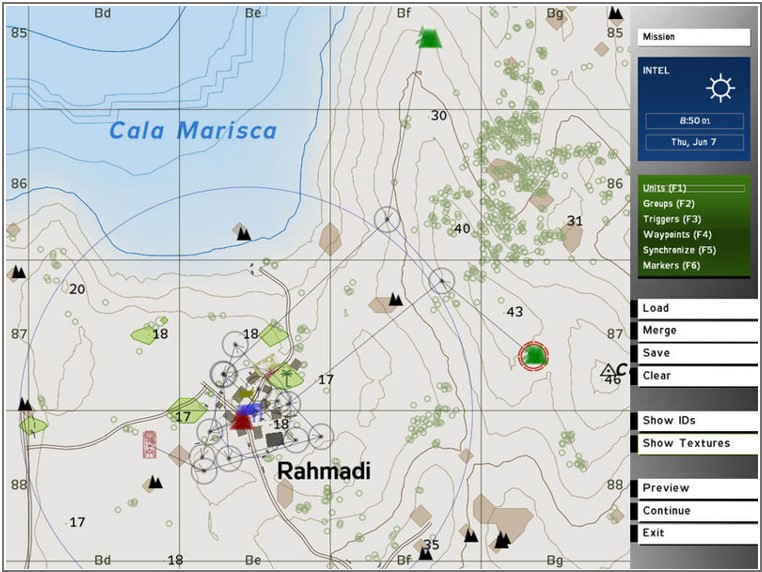
Fast forward ten years, after playing Fire in the Lake and Cuba Libre, I joined the COIN Discord community. I found a vibrant group of hobbyist designers developing their own prototypes which reminded me of my early tinkering days. That’s how my journey in wargame design began.
The most rewarding part of this experience has been meeting people from the gaming community and forging new friendships. These interactions have changed my worldview, influencing me far beyond just game design and wargames.
Grant: What designers would you say have influenced your style?
Yann: This might be more of a mentorship than an influence, but I have to highlight the early guidance I received from Joe Dewhurst (The Pure Land) and Stephen Rangazas (Sovereign of Discord, The British Way, The Guerrilla Generation). Their expert advice in the initial stages of designing A Fading Star was invaluable. Their unique perspectives, rooted in their extensive experience in development for Joe and political sciences for Stephen, enriched the design process considerably. Stephen’s academic approach to civil war game design, and his candid acknowledgement of the COIN System‘s limitations, played a critical role in how I approached the model and its adaptability during all stages of the design up to now.
Fred Serval’s work, through both his Homo Ludens YouTube panels and his design on A Gest of Robin Hood, significantly influenced my design process as well. Finally, I’d like to mention Saverio Spagnolie, who shared excellent advice and inspired me through his dedicated efforts in onboarding new players into complex systems like the COIN/Irregular Conflicts Series, as he achieved with the Vijayanagara team.
Grant: How do you feel about designing a game in such an established and venerable series as the COIN Series?
Yann: Do not get me wrong, it is a profound honor to follow in the footsteps of such esteemed designers as Volko Ruhnke, Mark Hermann, and Brian Train, I assure you! However, I primarily view this opportunity as a humbling endeavor. Beyond being “COIN Vol. XV,” I perceive A Fading Star as a moment of attention, an opportunity to present a narrative that is scarcely represented in Western media. This mission to tell a largely untold story has been my primary motivation to strive for commitment in my work.
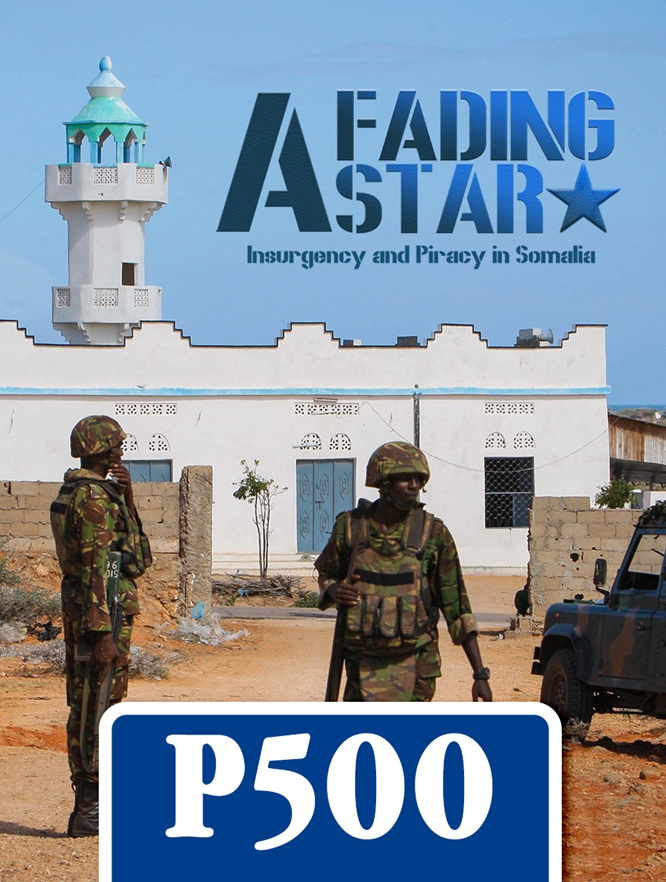
Grant: What historical period does A Fading Star cover?
Yann: A Fading Star delves into an eight-year stretch of the ongoing Somali Civil War (which began in 1991), from 2007 to 2015. Players observe the ascendance and prime of the Islamist organization “Harakat al-Shabaab al-Mujahideen” (Al-Shabaab). The game is focused on the period when their initial leader, Ahmed Abdi Godane, conducted an intense insurgency, coerced rival factions to unify under Al-Shabaab, and nearly toppled the then fragile federal Somali state. The game concludes historically with his demise and Al-Shabaab’s expulsion from their primary urban strongholds by the African Union coalition. While Al-Shabaab remains a substantial threat today and governs parts of South Central Somalia, they’ve never truly regained the control and momentum they had during this period.
Grant: What was the inspiration for the title?

Yann: The title “A Fading Star” is a creative invention, purposefully designed to echo the names of previous entries in the series like Falling Sky and A Distant Plain. The star in Somalia’s flag and coat of arms traditionally symbolizes the regions inhabited by the Somalis. The gradual dimming of this bright white star in the title signifies the looming threat to the nation’s existence from Al-Shabaab (represented by the black flag) and their attempted takeover.
Grant: How does the subtitle help frame up the expectations for players?

Yann: Excellent question! If you’re familiar with the COIN Series, you’ll know that previous volumes often have subtitles like “Insurgency in Afghanistan, Cuba, Philippines…”. A Fading Star also deals extensively with the issue of sea piracy, how it takes root on land, and its intersection with various political entities. This presents a parallel narrative to the insurgency, with striking similarities like the initial security-centric response that overlooked its social and political aspects. Through the game, we attempt to debunk the widespread fear during that time of complete collusion between pirates and terrorists, which was also fictionalized in wargames from the previous generation (e.g., Somali Pirates).
Some past COIN Series volumes have received fair criticism for their ‘green’ or fourth faction, which part of the public perceived as being shoehorned in, not worth a full-blown faction or historically inaccurate. However, in A Fading Star, the ‘Pirates and Minor clans’ faction has been given thorough thought in design and narrative depth, which justifies its mention in the subtitle. Although the game primarily highlights the Al-Shabaab insurgency, players can anticipate a comprehensive historical representation of the piracy phenomenon through both gameplay and design notes in the playbook.
Grant: What research did you do to get the details correct? What one must read source would you recommend?
Yann: To ensure the game’s accuracy, I relied on a bibliography of around 40 books and papers, primarily from scholars and doctors with expertise in Horn of Africa affairs, political violence, piracy, and counter-insurgency.
My approach was constructivist, acknowledging the range of perspectives due to the ongoing nature of this conflict. There are a variety of viewpoints on the insurgency and Somali piracy phenomenon, and these differ based on scholars’ theoretical leanings, their proximity to the conflict, and the time period they’re examining. I’ve ensured these diverse perspectives are reflected in the game, without claiming to offer a definitive conclusion on the Somali Civil War.

A great example of this approach is the modeling of the contrast within the AMISOM faction, highlighting the failures of the unilateral Ethiopian and Kenyan, power-play-motivated interventions versus the potential of the internationally sanctioned, African-led peacebuilding coalition embedded in multilateralism.
As for introductory must-reads, I highly recommend Inside Al-Shabaab by Harun Maruf, a VOA reporter, and The Pirates of Somalia by Jay Bahadur, one of the few Western journalists to provide an insider’s perspective on Somali piracy. Perhaps the greatest influences on the design came from reading works by leading experts Stig Jarle Hansen from the Norwegian University of Life Sciences, and Paul D. Williams from Georgetown University.
Grant: What is the historical run up to the game’s start in 2007?
Yann: Simply put, South-Central Somalia was mired in warlordism from Siad Barre’s exile in 1991 until 2006. That year, the warlords were overthrown by another coalition of clans, Islamic factions, and businessmen under the Islamic Court Union’s banner. Ethiopia invaded Somalia, perceiving the rise of this more centralized faction as a threat. They also brought along the Transitional Federal Government of Somalia, which until then was barely governing anything. We delve deeper into these events in an InsideGMT article available here.
Grant: Who is Harakat al-Shabaab al-Mujahideen? How do they differ from other insurgencies?
Yann: Harakat al-Shabaab al-Mujahideen originated as a split-off from the Islamic Court Union. While the ICU’s less ideological parts fled to Eritrea or surrendered, this Wahhabist, jihadist militia started an intense insurgency against Ethiopian, AMISOM, and federal forces. They’re affiliated with Al-Qaida, but crucially they remain a local insurgency using anti-Ethiopian sentiment, social and economic factors, and clan grievances to stay relevant. Their cadres learnt from the Taliban insurgency and Al-Qaida Afghan training camps, which is evident in their strategies, but they also developed a model suited to Somalia’s failed state situation, explaining their resilience.
Whenever possible, they sought community support by bringing governance and Sharia ruling in areas that were using secular pastoralist or clan justice, which often sidelined minor sub-clans. Clan grievances, poor governance, and the complicated economical environment have always been the organization’s bread and butter. And while, as with all Somali factions, it remains constrained and divided along clan lines, it is the one that achieved the strongest unity by having a strong centralized executive body (the shura), while their provinces are administered by solidly implemented local supporters.
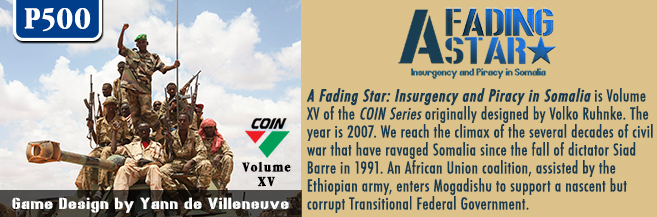
Grant: How have you created an updated take on contemporary aspects of insurgency and peacebuilding?
Yann: This is not an extensive list, but for example the Al-Shabaab faction explores modern facets such as online propaganda and media warfare (the Broadcast Special activity background is explained here). The use of Terror is also more intricate than that in previous volumes, and better reflects why insurgents rely on such extreme strategies at an operational scale, beyond eroding government support and credibility. Terror allows Al-Shabaab to racketeer businesses outside their controlled areas, disrupt COIN resilience by targeting their officials and command chain, and exert pressure on local clans to cooperate with their counter-intelligence services to avoid detection during cell movements.

The AMISOM faction also grapples with unique aspects: they are officially on a peace building mission, but how do you enforce peace while the insurgents are just a stone’s throw away? And what happens when dealing with difficult allies like Ethiopia and Kenya who first intervened outside the scope of an internationally sanctioned mission? What do you do when you’re lacking basic kinetic capabilities? These questions are deeply embedded in the design of the game and will be discussed extensively in a future InsideGMT article. Another aspect that is more focused than in previous series is how critical training the federal forces is to the international community’s end goal in Somalia. Yet, the task won’t be as easy …
I would like to again extend my gratitude to Stephen Rangazas, whose insightful perspectives and resources have been invaluable in shaping these particular aspects of the game.
Grant: How has this created a different experience for the COIN Series?
Yann: One of the most exciting aspects of designing A Fading Star was the ‘lab work’, examining how veteran players would adapt to their respective factions in light of previous volumes and the specific nuances of the conflict.
Perhaps the most significant difference comes from the faction interplay. The COIN factions are under constant pressure from Al-Shabaab, creating a less pronounced asymmetry. Minimal coordination could lead to COIN factions’ downfall, yet, the potential for enmity between AMISOM and TFG factions is more considerable than in previous volumes. The two can be significantly adversarial to each other.
AMISOM, for instance, could focus more on its political end goal of decentralized state-building and neglect training the national army (both are cumulative victory conditions). This leaves TFG less self-sufficient than ARVN or ANA in other volumes, forcing it to rely on friendly local militias. Conversely, the federal government has expanded ways to divert security reforms and sabotage the regional state-building process for its own gain. Playtesters described this relationship as abusive and electrical, which I believe are historically accurate descriptions of the bond between successive presidencies and Somalia’s international partners, especially its immediate neighbours Kenya and Ethiopia.
Al-Shabaab’s players also showed interesting adaptation. Initially, playtesters focused on the traditional Rally/Tax loop, before realizing they had more agency and momentum than older insurgent factions. Al-Shabaab can act, and COIN must react. This isn’t a typical cat-and-mouse game, and in some situations, Al-Shabaab can actually be the cat, particularly if neither Ethiopia nor Kenya is intervening.
Grant: What are the four factions portrayed?
Yann: Here is a list of the 4 factions and their motivations:
- The African Union Mission in Somalia (AMISOM): This faction also includes Ethiopian and Kenyan forces which may act outside the mission’s mandate. AMISOM seeks to support the transitional federal government security sector reforms in Somalia and stabilize the areas freed from Al-Shabaab by shaping what would later become the decentralized Federal Member States of Somalia (FMS).
- The Transitional Federal Government (TFG): The TFG aims to extend its control beyond Mogadishu, centralizing power by getting the FMS in their pocket, and maintaining a kleptocratic system relying on patronage and foreign aid. This faction seeks to take advantage of the presence of AMISOM to expand its influence and strengthen its legitimacy.
- Al-Shabaab: This is the primary insurgent faction. Al-Shabaab drives much of the game’s narrative as they wage a high-intensity insurgency against the federal government and AMISOM. Their goal is to establish an Islamic state in Somalia.
- Pirates and Minor Clans: This faction represents independent communities taking advantage of the power vacuum created by the conflict. Their interests and benefits are threatened by the war and the ambitions of the other factions. This faction showcases the dynamics of piracy and the role of minor clans in the conflict.
Grant: What is the power hierarchy here?
Yann: As mentioned above, the AMISOM faction’s kinetic abilities evolve depending on Ethiopia and Kenya joining the fray (through Events or checks made during the Clan Struggle phase, which we cover further below).
AMISOM with both active interventions will tear apart a too aggressive Al-Shabaab. But the Insurgent can give them some serious troubles if only the core AMISOM and Ethiopian troops are present, overstretching can be easily punished and cities contested. Al-Shabaab can even militarily contend with the COIN factions if neither country is intervening, and threaten Mogadishu without having to resort to their “Ramadan Offensive” cards. The TFG, on its own, falls behind Al-Shabaab in terms of military strength.
Regarding the Pirates, their offensive operations, termed “Intimidate,” is mostly successful in areas without established Control or Opposition/Support, reflecting regions where subclans are more fragmented and no major power is monopolizing military or political influence. They cannot remove AMISOM pieces, indicating their limited offensive capability.
Grant: How much of a focus is the city of Mogadishu?
Yann: Mogadishu is a major focus in A Fading Star, especially in the early stages of the game. The capital was under a state of siege and it took almost five years for AMISOM and the Transitional Federal Government (TFG) to liberate it from partial control by Al-Shabaab. This was among the most violent urban battles of the 21st century, occurring in a sprawling, bustling metropolis.
In terms of game mechanics, Mogadishu is divided into several sub-areas called Districts, reflecting the urban complexity of the capital. This structure plays a pivotal role in the gameplay as the COIN factions need to gain control of a majority of the districts to establish overall COIN control of Mogadishu. The challenge for players, much like in real urban warfare, is that progress is slow and requires careful planning and resource management. For example, when a faction selects Mogadishu for an Operation or Special Activity, they can only target one District, forcing them to strategize their moves.

Another crucial aspect for the COIN factions is securing their lines of communication within the city (the Street District), which is essential for maintaining the effectiveness of their Sweep operations.
This focus on Mogadishu offers an array of exciting gameplay elements, mirroring the city’s historical significance and the unique challenges posed by urban warfare. There are a lot of other gameplay aspects which players will find exciting, and which I hope will help convey the tension within the city.
Grant: How does the control of a majority of districts provide the ruling faction with further legitimacy and enhanced capabilities?
Yann: The control of a majority of districts in Mogadishu confers significant advantages to the ruling faction and reflects a deeper, political reality: that major clan elders and power brokers within the city are starting to align with the winning side.
For the COIN factions, controlling Mogadishu implies military achievements and political consolidation. This control accelerates the process of State Building, a critical component in this game that replaces the conventional Civic Action mechanism. Without a consolidated and secured Mogadishu, this process takes longer and can easily be outpaced by Al-Shabaab application of sharia. In addition, controlling the capital enhances AMISOM’s ability to garner support when they train troops for the Somali National Army.
For the Transitional Federal Government (TFG), controlling Mogadishu means they can start expanding their political and clan networks outside the capital, without the constant threat of a siege. They can also negotiate with the Federal Member States to quickly muster friendly militias sent by allied clans, although this often comes at the expense of state-building efforts.
Alternatively, if Al-Shabaab gains control of the capital, their influence spreads, and they can build opposition in more locations simultaneously. The successful control of Mogadishu enables their Propaganda Special Activity, Broadcast, to place Cells anywhere on the board, even in spaces that are at Active Support. This reflects the reality that a victory over a coalition of foreign conventional forces in a key city like Mogadishu would have been heavily promoted through all their available channels.
The Pirates and Minor Clan faction cannot secure Mogadishu as a whole, but they can benefit from control of trade and commerce if the Streets and Port remain uncontrolled by anyone else.
Grant: What is the Clan Struggle interphase and how does it draw out some of the conflict’s unique uncertainties?
Yann: This new interphase mechanism interrupts the normal flow of the game, reminiscent of a “light” Propaganda phase. It brings some specific uncertainties of the Somali conflict to the fore and makes the game more dynamic and unpredictable.
The interphase begins with the Pirates and Minor Clans faction collecting resources from lines of communication and ports they control, representing an alternative means of achieving victory aside from piracy.
Next, AMISOM has to check the position of potential troop-contributing countries such as Kenya and Ethiopia. This mirrors the historical realities of regional powers declaring their intentions to intervene, but then delaying or withdrawing due to logistical or political complications. These changes could result in an influx or reduction of ground forces and capabilities.
The Transitional Federal Government (TFG) then faces the problem of troop and militia desertions, a challenge echoed in previous volumes of the series. Such desertions also undermine AMISOM’s efforts to build a credible Somali National Army.
Lastly, all factions participate in a resource bid for the favor of a major Somali subclan. Winning this bid allows a faction to add forces and a base in selected areas. However, if there is a tie in the highest bid, it represents a split within the subclan, leading to infighting in those areas. This needs to be addressed before support or opposition can be built, adding another layer of complexity and uncertainty to the game.
Grant: What is the piracy subsystem? How does it work?
Yann: The piracy subsystem offers an interesting layer to the game that reflects the historical occurrence of piracy off the Somali coast during its peak between 2006 and 2013. It involves operational aspects, economic considerations, interactions with other actors and the civil society, hijacking tactics, and counter-piracy responses.
The Pirates have three key related Operations and Special Activities: Raise Trouble, where they attempt to hijack ships in the Indian Ocean; Ransom, where they negotiate ransom payments for hijacked ships; and Relocate, where they can move their operations (including Bases) if circumstances become unfavorable.
A piracy attempt flows as follows:
Staging Ground: For a piracy operation, the Pirates player first decides which coastal area serves as a launching point. This represents the cooperation and funding among local communities and stakeholders. They then allocate resources that represent the expertise and equipment of the raiders.
Piracy Deck: The player then draws three cards from a dedicated Piracy Deck, which includes potential target ships, event cards involving other players, and modifiers based on common piracy or counter-piracy tactics. Over time, counter-piracy cards get added to the deck, reflecting increasing counter-piracy measures.
Hijack Attempt: If a Target card is present, the Pirates can attempt a boarding by rolling a dice against the Target’s hijack value. Modifiers to this attempt can include resources spent, revealed cards, and the presence of pirate kingpins (Bases), Al-Shabaab, or the TFG in the staging area.
Anchorage and Ransom: If the boarding attempt is successful, the Pirates choose an Anchorage area to hold the crew hostage until a ransom is delivered. The choice of Anchorage area depends on the Pirates’ logistical capabilities, with larger targets requiring a more established network. If the Pirates cannot secure a safe Anchorage area, they must risk anchoring in an area controlled by the COIN factions or Al-Shabaab, where they have to negotiate with these factions (TFG in COIN-Controlled areas) when they later ransom the crew.
That is just a broad description, players will find that the piracy deck has a few more peculiar surprises for them, including for the non-pirate factions. The piracy subsystem is designed to resolve quickly and smoothly, in order to not disrupt the flow of the game while encouraging all players to keep an eye on the Pirates’ actions, enhancing the interactive experience of the game.
Grant: Why is this aspect important to model?
Yann: To remain truthful, there was definitely a possibility for A Fading Star to solely focus on the Al-Shabaab insurgency in a 3-player or even 2-player format. Why then did I include a Pirate and Minor Clans faction? This inclusion is an essential tool for accurately representing the multi-faceted nature of South-Central Somalia. These elements illuminate two key aspects of the socio-political environment in Somalia during the 2000’s.
Firstly, this model addresses a common misconception about piracy: the perception, particularly prevalent in Western societies, that piracy is primarily a sea-based threat. Drawing from recent academic research, the game posits that Somali piracy is more accurately understood as a land-based threat, its proliferation contingent upon particular social and economic contexts. However, historical responses to piracy often emphasized costly, security-first-oriented strategies at sea, while neglecting the root causes ashore. This oversight echoes a broader pattern of ineffective counter-insurgency strategies that emerged during the era of the War on Terror. The COIN system provides the appropriate toolkit to scrutinize this issue.
Simultaneously, the game deconstructs the notion of a so-called “pirate-jihadist” nexus, in which terror and hijacking groups were feared to benefit from mutual cooperation. Such assumptions fostered concerns that Al-Shabaab could potentially acquire expertise to compromise maritime targets or cultivate sea-based capabilities. A Fading Star demonstrates that these groups interacted in limited and non-systemic ways, largely due to their distinct organizational characteristics.
Secondly, the game acknowledges the power vacuum and state failure context within which the Somali Civil War transpired. A prevalent misbelief suggests that life within a failed state is characterized by systemic chaos, societal terrorization by warlords, and ongoing underdevelopment. However, this model counters such views, demonstrating that local communities and elders often maintained societal order in many regions. The Somali customary law (xeer), for instance, offered a rudimentary judicial framework for resolving common disputes. Clan meetings also remained a prevalent method for addressing more significant issues, often bypassing the need for state intervention or the application of Islamic law.
This aspect is embodied in the “Minor Clans” element of the Pirates faction. It is illustrated through the shifting Opposition and Support during the Propaganda phases and the Intimidate Operation. The latter allows minor clans to arm themselves in response to external influences, particularly in Uncontrolled or Neutral areas. This element serves as a reminder that sub-actors in civil wars often include smaller, local communities striving to maintain autonomy while resisting the influence of larger actors whose goals diverge from their own interests. Regrettably, these survival strategies in smaller communities and sub-clans occasionally involved unlawful activities, including piracy, roadblocks, and trafficking.

Grant: How are the Event Cards unique?
Yann: The Event Cards remain mostly faithful to the philosophy of previous volumes, although I must highlight once again Stephen Rangazas, as well as Jason Carr, in the influence over picking the cards that “made the cut” in the current design and the themes behind it. The latter once wrote that events should ideally be “a modeling of external pressures on the core model of the game” rather than just zooming in on aspects that are already dealt with by Operations and Special Activities.
We strived to eliminate Events that were overly tactical and prioritize those that contributed more to the narrative flow of the game. A significant emphasis was placed on portraying historical figures, lieutenants, sub-actors, foreign interference, civil society, and some unique aspects of the Somali theater.
The Event Deck also includes a few “black swan” cards. These cards only have a single effect and no shaded or unshaded options, meaning the factions sometimes do not have the ability to avoid the impact of these events. The intent behind this is to simulate unpredictable, high-impact events that can significantly alter the course of the game, and the reality of small powers’ agency in the international arena.
Grant: Can you share a few examples of these cards?
Yann: A couple of the Event Cards are based on the presidencies of Somalia from 2007 to 2014, and come with unique effects that reflect the real-life political changes these individuals brought about. For example, the card featuring Sharif Sheikh Ahmed, the former leader of the Islamic Courts Union, signifies the surprising shift in domestic power politics following his election by Somali elites. His surprisingly peaceful assumption of the Villa Somalia seat led to the withdrawal of Ethiopian armed forces and a decrease in Al-Shabaab’s influence, as political opposition became more effectively represented.

We also delve into more intricate aspects of modern peacebuilding and the challenges faced by multilateral efforts in security sector reforms. For example, the “SNA Biometric ID’s” Capability allows the AMISOM faction to implement biometric identification for all new Somali recruits, reducing attrition during the Desertion Phase. In the real-world context, this measure was lately introduced to prevent the creation of a “ghost” army – fictitious personnel who exist only on paper, an unfortunately common occurrence in contexts of instability and corruption.

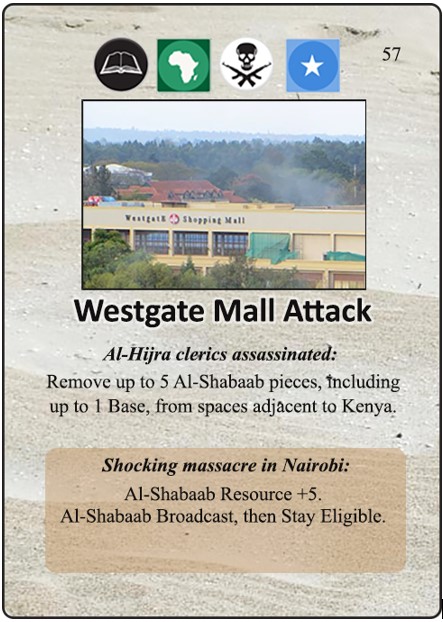
To conclude with those examples, the “Westgate Mall Attack” card is one that carries significant weight. This event card references the tragic 2013 terrorist attack by Al-Shabaab that took 67 lives in Nairobi, Kenya. This is an instance where we tackle the difficult question of why insurgent organizations with primarily domestic agendas resort to external attacks, often for propaganda purposes. The inclusion of this card underscores the reality that Al-Shabaab has had the capacity to strike terror into countries participating in counter-insurgency efforts, while keeping momentum on the front lines in Somalia. The card also has unique gameplay implications. Certain Event Cards, like the Westgate Mall Attack, permit the executing faction to remain eligible for further actions on the next card. This can potentially trigger a chain of impactful effects, a design approach I’ve drawn from the brains behind the Irregular Conflicts Series Volume One Vijayanagara.
Grant: What is the difference between Event Cards and Piracy Event Cards?
Yann: Piracy Event Cards are only found in the Piracy Deck and are resolved immediately upon being revealed during a piracy attempt. There are only a few of them, and they represent how piracy interacts with other actors in Somalia. They often present a dilemma or offer for the Pirates or another faction that can alter their relationship to each other. After being used, they are shuffled back into the Piracy Deck during the Reset phase, ensuring that players will become familiar with them over time.
Grant: Can you share a few examples of these cards?
Yann: Certainly, let’s take a look at a couple of these cards:
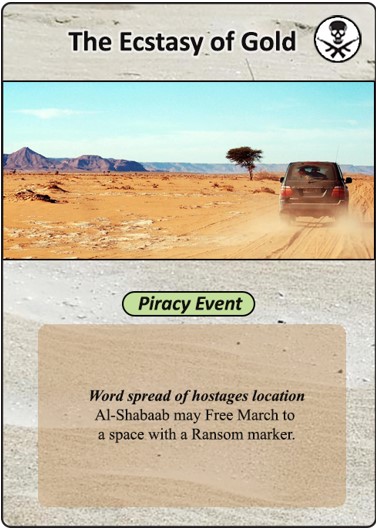
The Ectasy of Gold: This card presents an interesting opportunity for the Al-Shabaab faction. Historically, while Al-Shabaab’s executive council officially condemned piracy, certain local leaders did engage in arrangements with pirates, receiving a significant “tribute” from ransoms in areas where the group had influence, such as the town of Xarardheere. This could amount to hundreds of thousands or even millions of dollars. As you can imagine, this prospect raised some curious patterns in cases where the ransom was expected to break records. In the game, when this card is revealed, it can motivate the Al-Shabaab player to move Cells toward an area where hostages are being held, potentially gaining a substantial reward.
Himan and Heeb: This card underscores the intricate relationship between pirate leaders, such as Mohamed “Afweyne” Abdi Hassan, and local authorities in areas with minimal state control. It also raises questions about the extent to which pirates could manipulate officials to their advantage. In the game, when this card comes into play, it highlights the complex interactions and potential collusion between pirates and local elites, which can influence the power dynamics amidst an accountability vacuum.

Grant: What does the board look like? What areas are some highlights?
Yann: Because Somalia is arid, lowland topography did not play a prominent role in determining how the operations were conducted, the type of terrain is the same for all Provinces, making the map rather easy to read. I hope this will allow us to create a more elegant board with a unique identity, as some of the incoming COIN Series and Irregular Conflicts Series releases have set the bar really high!
Certainly, one of the major highlights of the board is the capital city, Mogadishu, represented by its five distinct Districts whose simple layout allows for a streamlined modeling of modern urban warfare.

Economic Centers also return through the “Major Harbour” spaces. These spaces are points of interest where all factions can potentially benefit from prosperous port activity, adding an additional layer of strategic consideration.
Last but not least, Coastal areas are emphasized on the board to aid the Pirates faction in determining their operational staging grounds.
Grant: What type of an experience does the game create?
Yann: That is a question whose answer is still developing as playtest results and feedback keep coming in. The intent was to put player interaction in the forefront, with the focus above the table. This is where I hope the design will shine, and that players will not necessarily have their eyes riveted on their player aid. That is another reason I hope we can achieve a smooth new player onboarding trajectory.
Another goal is to deliver a game that can be enjoyed within a short afternoon. We designed the victory conditions to be slightly more volatile, leading to a game that often feels like a race to a moving finish line. This dynamic deviates from the more common COIN scenario where all players gangpile against the leading player and offers a fresh, tense gaming experience that keeps all players on their toes.
Grant: What are you most pleased about with the design? What has been the response of playtesters?
Yann: An originally unintended and surprising aspect that came up during playtesting was the game’s high replayability and “sandboxy” nature. We’ve seen playtests culminate in a diverse array of outcomes, some of which have genuinely surprised us! Playtesters have also reported an appreciation for the strategic depth of the factions, particularly for Al-Shabaab. The overall response to the latest iterations of the design has been overwhelmingly positive, to my relief.
Still, one of our primary challenges lies in ensuring that players can identify and enjoy the faction that best suits their style, given the even more pronounced asymmetry of power dynamics in A Fading Star. For example, the Transitional Federal Government (TFG) faction is centered on a small patronage engine-building dynamic with less agency in the early stages of the game when they are under siege. The first turns can be pretty rough for them!
The African Union Mission in Somalia (AMISOM) faction’s modular operations and special activity may initially seem overwhelming to new players. Similarly, players who try to confine Al-Shabaab to a repetitive Rally+Tax loop may miss out on the key features of the faction, and as such its narrative. Lastly, those who prefer more cutthroat strategies might not fully enjoy the Pirates faction, where diplomacy and negotiation are vital. It might be wishful thinking, but if in the future you are hosting a game with newcomers to the series, please make sure to quickly run them down on what their faction entice and avoid random attribution! We will provide the assets to assist with that.
Grant: What other designs are you working on?
Yann: Currently, A Fading Star is the only game design that I’m actively involved with. Over the last couple of years, I have drafted several proof of concepts, but none of them have truly resonated with me enough to transition into the design phase. I am intrigued by the possibility of exploring topics such as the illegal gold mining in French Guiana and its environmental impact on indigenous tribes, but nothing is concrete as of yet.
For now, my attention is centered on playing more (war)games, completing my International Relations Master’s degrees, and investing serious time into researching potential subjects that have political implications, even if they are not overtly military. Lastly, even though it might be tempting to utilize established game systems like COIN, if one day I go back to the design table, it will be with as much “original” game mechanics as possible. This might make the game less marketable, but it’s a risk I’m willing to take in the pursuit of modeling the nuances of historical conflict right.

Thank you so much for your time Yann in answering our questions. I really appreciate your attention to detail and it is very apparent that you have done your homework on the subject. This bodes well for this game and I very much look forward to playing it.
If you are interested in A Fading Star: Insurgency and Piracy in Somalia, you can pre-order a copy for $69.00 on the GMT Games website at the following link: https://www.gmtgames.com/p-1021-a-fading-star-insurgency-and-piracy-in-somalia.aspx
-Grant
 The Players' Aid
Great interview. When Yann pointed out the Western view of piracy is it happens on water, I would agree.
Very insightful and respectful treatment of the subject matter… another one for P500.
LikeLiked by 1 person
And what does that have to do with anything?
LikeLike
Lmfao 🤣
LikeLiked by 1 person