In case you don’t know, David Thompson is a really talented designer who has been putting out lots of really playable and entertaining wargames over the past couple of years. One of his finest efforts has been the 2019 hit Undaunted: Normandy, which is a card based small squad tactical game that uses deckbuilding and a modular board with scenarios to tell the story of the 30th Infantry Division as they marched across Europe following their landing on D-Day during World War II. Due to that game’s success there have been two expansions in the series released to date, one that is a stand-alone game called Undaunted: North Africa and a second that is called Undaunted: Reinforcements that adds cards and scenarios to both Normandy and North Africa along with a solitaire mode. And just released this past year was the 4th installment in the series called Undaunted: Stalingrad, which is a bit of a new animal to the series as it includes some Legacy style mechanics, where conditions and cards change over the course of a campaign making each play a bit different. David and Trevor have teamed up once again to keep the spirit of the Undaunted Series alive and kicking with their next stand alone game in the series called Undaunted: Battle of Britain. I reached out to David and asked if he would be willing to answer some questions, and as always he was more than willing to share.
Grant: Where is the setting for your newest entry into the Undaunted Series?
David: One thing that Trevor and I feel very strongly about for the Undaunted Series is that each game needs to bring something new and fresh. Normandy was the first game in the series, North Africa changed the scale and really pushed for asymmetry in gameplay and goals, Reinforcements added solo and team play (as well as some new toys), and Stalingrad provided a legacy-style campaign experience. With Battle of Britain we’ve changed up the core gameplay more than ever before, while still staying true to Undaunted’s DNA.
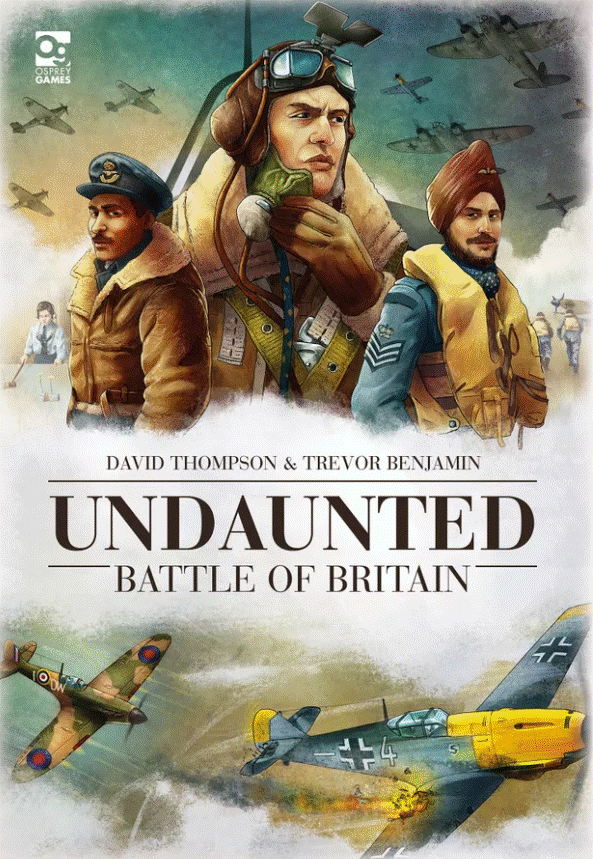
Grant: What did you want to make sure and model in the design from the history of the Battle Britain?
David: There are already so many great games on the Battle of Britain at different scales and focuses. We knew early on that we wanted to keep things at the personal scale, since that has always been a core identity of the series. But beyond that we were very open to different ideas. For the first few months of the project, we just concentrated on researching the topic. Eventually we settled on the idea of cohesion between aircraft sections as one of the most unique elements of the game. Other elements such as maneuver also clearly had to be instrumental to the game, but we hadn’t seen other games that elegantly modeled the importance of communication between a pilot and their wingman.
Grant: What type of research did you have to do and what were some of the sources you used?
David: We identified a TON of Osprey books that would help us out with the research stage (one of the obvious benefits of making a military-themed game with Osprey is their massive catalog of military history books). Osprey sent them over right away and Trevor and I pored over them, trying to identify the right time period, regional focus, and scale for our game.
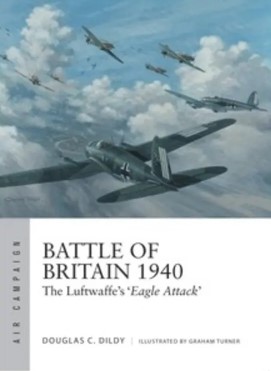
Here’s a sample list of sources we requested from Osprey early in the design:
- Battle of Britain 1940
- The Royal Air Force 1939-45
- The Battle of Britain
- Mosquito Photo-Reconnaissance Units of World War 2
- Britain’s Air Defences 1939-45
- Britain’s Home Defences 1940-45
- German Flak Defences vs. Allied Heavy Bombers 1942-45
- RAF Fighters vs Luftwaffe Bombers
- Spitfire vs. Bf109
- Hurricane vs. Bf110
What’s interesting about this list in retrospect, is you can see that we were still scoping the extent of the time period covered in the game. At the time, we were still considering extending the focus of the game beyond the Battle of Britain and to the period of allied bombing of Germany.
Grant: What did you have to sacrifice from history to make the game more playable?
David: Altitude! This is something we toyed around with a LOT in the early days of the design. We wanted altitude to be relevant but elegant. We tried lots of different systems, but ultimately everything we tried just moved us a little too far from the core Undaunted play patterns, and we just didn’t feel there was enough payoff for the increased “rules grit.” I know a lot of folks won’t be happy about the exclusion of altitude, but what I will say is there are so many different WW2 aerial combat games out there that model altitude that if it’s a game breaker for trying Undaunted: Battle of Britain, then those folks have lots of awesome alternatives.
Grant: How has the Undaunted System changed for this game? What is new to the system in this volume?
David: There is the obvious difference of the transition from offset squares to hexes for the board. Topographically the two are essentially identical. However, Undaunted: Battle of Britain uses facing for the aircraft (that is, it matters what direction the aircraft counters are rotated), and that facing is easier to track with hexes.
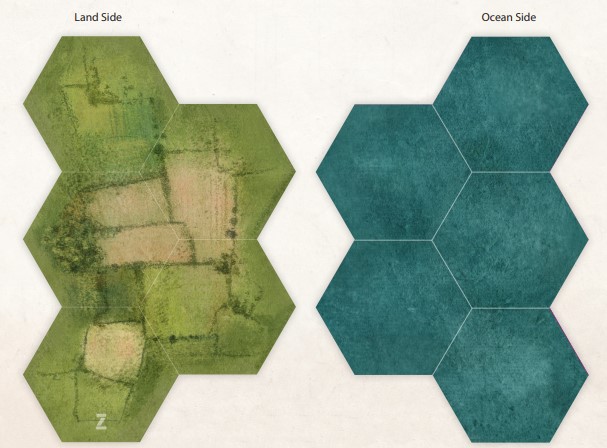
Also, in Undaunted: Battle of Britain we’ve moved away from the idea of scouting. In the other games in the series, when a scout moves to a new terrain tile, you place a scout token on the board and gain a Fog of War Card. The Fog of War Card represents the strain on command and control within the unit as the scout expands the area covered by your unit. That concept doesn’t really apply in aerial combat. Instead, we’ve introduced the idea of maintaining communications between aircraft.
Grant: What is the scale of the game?
David: Undaunted: Battle of Britain is closest to Undaunted: North Africa in scale. Each counter represents a plane. Most planes only have one crew member – the pilot. In those cases, each pilot has three or four cards associated with them. In the case of aircraft with multiple crew members, each crew member has a single card.
Grant: As you mentioned, the tiles now have hexes. Why was this important to your vision for the design?
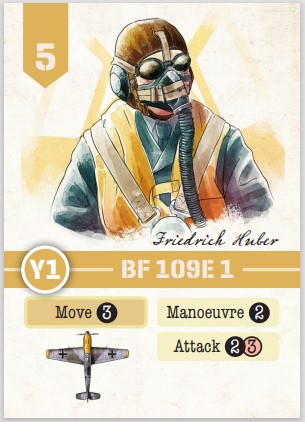
David: Planned movement is much more of a critical element of the game in Undaunted: Battle of Britain. Each plane has a Move Rating, ranging from one to three hexes, that it can move in a single action. Accompanying that Movement Rating is a Maneuver Rating. The Maneuver Rating determines how many times you can rotate the plane counter during each action. So, for example, if you have a Spitfire that can Move 3 and Maneuver 3, you could move it up to three hexes and rotate it three times, all in one action. Each rotation must be broken up by movement of at least one space. Now compare that Move and Maneuver of the Spitfire to something like a Luftwaffe bomber that only has a Move and Maneuver Rating of 1. But despite the superiority of the RAF fighters over the Luftwaffe bombers, the RAF will also have to deal with German fighters (and of course both sides will have to deal with obstacles such as barrage balloons and environmental conditions such as clouds). And one last note about movement and maneuvering in Undaunted: Battle of Britain: if you attack your opponent from the rear, you gain a significant bonus to the attack – something that should be exploited at all costs!
Grant: The Hunker Down action has always been important to the system. How has this been changed and replaced?
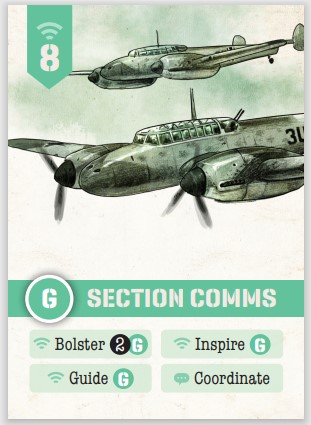
David: Hunker Down still lives on to some extent, though it is much more limited. You can now “Go Dark”, which allows you to discard your Communications Cards (Squadron and Section Comms) to the Supply. You can’t discard your Combat Cards (cards directly linked to specific aircraft on the board) to the Supply though.
Grant: What is the concept of Communications and why is this key to the design?
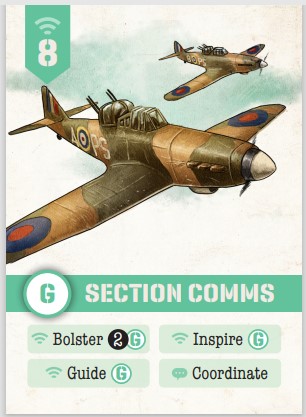
David: Each set of two fighters in the game are organized as a section. Those two fighters have a Section Comms Card, which operates similarly to a Squad Leader card from Undaunted: Normandy and Stalingrad. You can use the Section Comms Card to support the two fighters in the section (by adding new cards from those fighters, allowing them to take extra actions, etc.). However, if you use the Section Comms Card and the fighters are more than two spaces apart, you have to add a Discord Card to your deck. Discord Cards work just like Fog of War – that is, they are essentially a dead card in your deck. In this way, the game allows you to take important support actions with the Section Comms card if you want, but if the two fighters in a section are operating independently you will have to pay the price for the lack of cohesion.
Grant: Why the unique shape of the aircraft counters? Why did you make this choice?
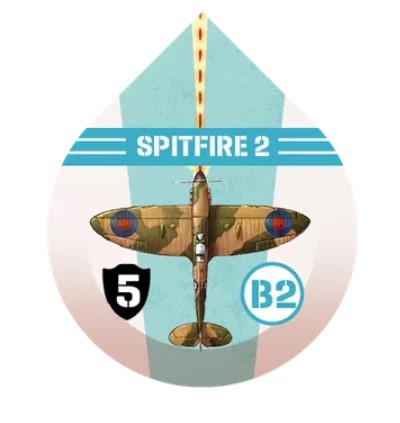
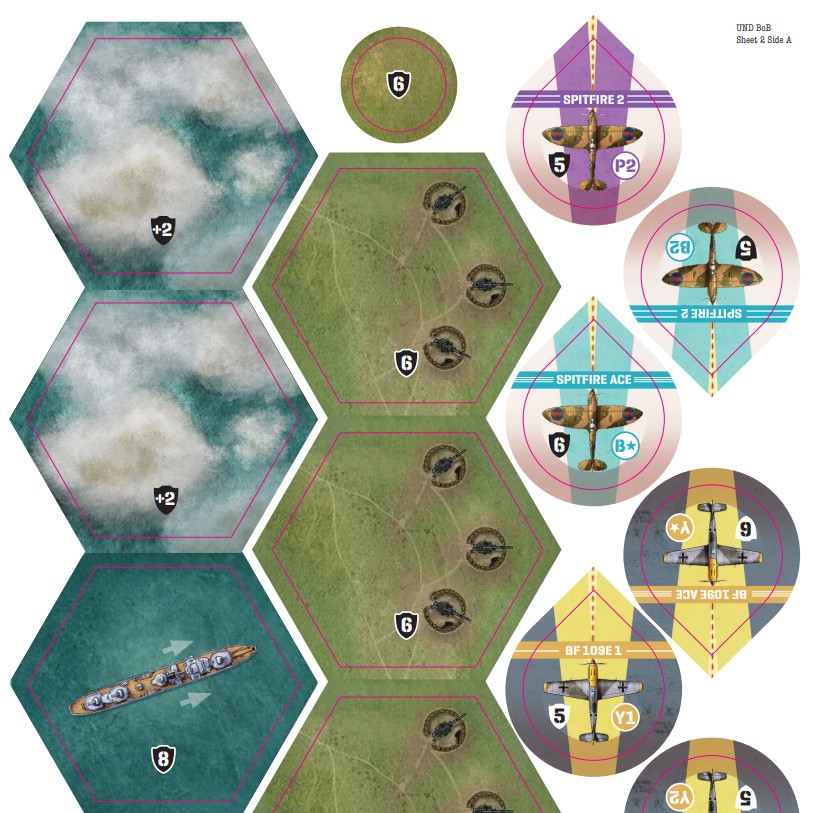
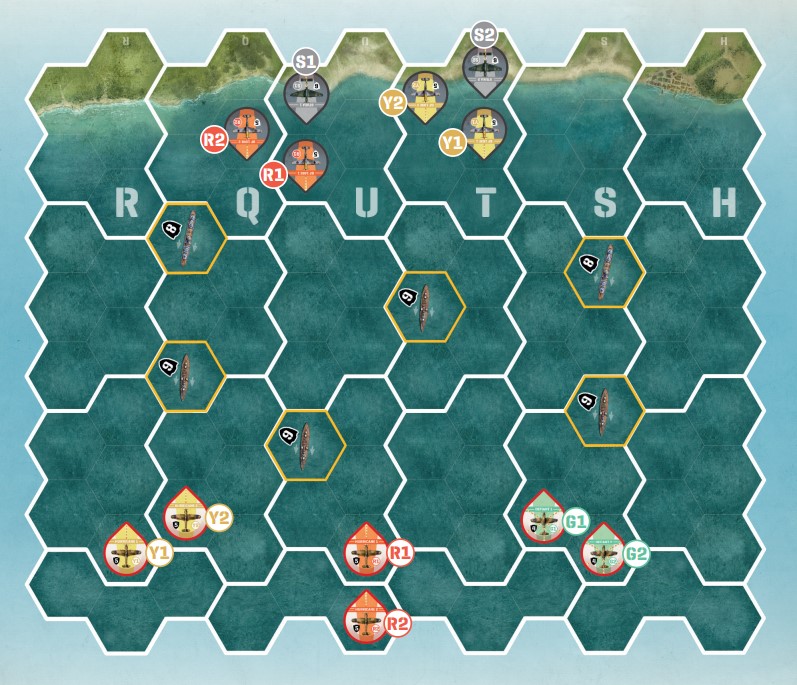
David: The Aircraft Counters have a sort of “teardrop” shape to them. It allows for an intuitive way to quickly recognize facing for the aircraft (as they are rotated to the hex side they face). Trevor and I didn’t make this choice – it was an awesome production choice from the Osprey team! It makes the game more playable and allows easy identification.
Grant: What are Decoy Counters and why are they important?
David: The game includes Decoy Counters for some of the Luftwaffe aircraft. They are used in one scenario to inject a type of “fog of war” into the game, requiring RAF fighters to close on the bombers and identify them visually.
Grant: What different types of markers are used in the game in addition to the tiles? What do these represent?
David: In addition to the Aircraft Counters, the game also includes markers for ships, AAA, clouds, and barrage balloons. Ships are included as targets for Luftwaffe bombers in quite a few scenarios. In some scenarios, the RAF player has limited ability to move the ships (trying to reach safety). AAA are used by the RAF player primarily in an attempt to disrupt Luftwaffe bombing raids. Clouds provide cover bonuses to aircraft, making them more difficult to target. And barrage balloons represent a deadly threat to both German and British aircraft.
Grant: Combat Cards and Communications Cards are important. What does each type represent?
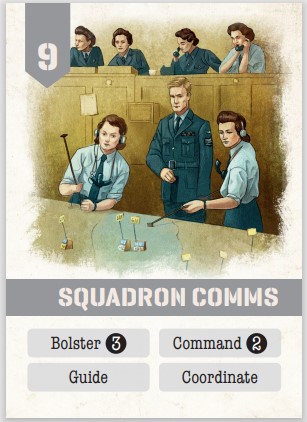
David: Combat Cards represent pilots and aircraft under your command. Each is associated with a Combat Counter (an aircraft). Communications Cards represent support staff on the ground and other assets at your disposal (such as AAA and ships).
Grant: Each time a Combat Card is played the player must move a counter. Why is this so important to the game? What type of decisions does it create for players?
David: We wanted the game to evoke the sense of constant movement in aerial combat. For that reason, when you play a Combat Card (that is, a card linked to an aircraft on the board), you MUST move the aircraft and you can also choose to take an action with the aircraft. This is different from other Undaunted Series games where movement is just an option you choose from a menu of actions. The obligation to move with an aircraft each time you play a matching card requires the player to pre-plan their movement, and it is especially important when there are deadly obstacles such as barrage balloons nearby!
Grant: What different Actions are available to players on the Combat Cards?
David: Move (which is obligatory as mentioned above), Maneuver, and Attack. In addition, Communications Cards include the following Actions: Bolster (adding more cards to your deck), Command (drawing cards into your hand), Coordinate (which is the action you use to get rid of Discord Cards), Guide (which allows you to move aircraft within a section), and Inspire (taking extra actions with a aircraft within a section).
Grant: How does combat work with line of sight and facing?
David: Unlike in other Undaunted titles, the aircraft in Undaunted: Battle of Britain can only attack in certain directions (which again, is easier to track with proper hexes rather than offset squares). Most fighters can only attack straight ahead, but some fighters (such as the Defiant!) and bombers can attack toward other hex-sides.
Grant: What value is needed to be rolled to shoot down an enemy aircraft?
David: When making an attack from one aircraft to another, you take into account the target aircraft’s Defense Value, range to the target, and any cover bonuses (provided by other aircraft, clouds, and barrage balloons). Once you’ve calculated the target’s defense, you roll a number of dice equal to the attacking plane’s attack value. If any one of the dice rolled is equal to or higher than the target’s defense, you score a hit. Usually a plane will have a higher attack value (meaning you roll more dice) if targeting an aircraft from behind. One tweak to Undaunted: Battle of Britain is that rolling a 10 on one of the dice is not an automatic hit.
Grant: What are X and Y values?
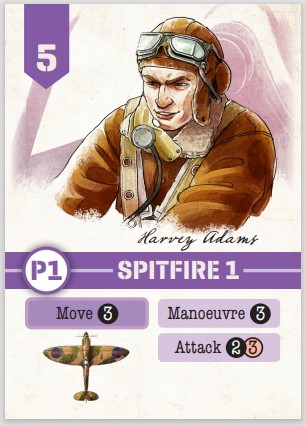
David: Any time you see an Action followed by an X value, it means that you check the specific card for the actual value. For example, in the rules an Action might be listed as Move X. For a Spitfire, the Move value on the card would be listed as Move 3 (meaning a Spitfire can move up to three hexes when you activate it).
Grant: How many different scenarios are included in the game?
David: Eleven. They are organized chronologically, with the first scenario taking place on 23 May 1940 (during the Battle of France in the lead-up to Dunkirk). The final scenario takes place on Battle of Britain Day (15 September 1940).
Grant: Is there a campaign option for the players?
David: The game includes a “campaign” that is similar to Undaunted: Normandy and North Africa. That is, there is a sheet that can be used to track the results of scenarios and compare those results at the end of the campaign. However, Battle of Britain is not a legacy-style game like Stalingrad. The results of one scenario do not impact subsequent scenarios.
Grant: What do you believe the design does really well?
David: Like all Undaunted Series games, I think it provides a fun, accessible war-themed game with extremely low complexity. It allows players to play a game that gives them the feel of WW2 aerial combat in just 30 or 45 minutes.
Grant: What is the overall play experience like?
David: It can vary significantly by scenario. There are dogfights, bomber intercept missions, etc. So each scenario will end up providing a fun, new experience to the players. But generally, it provides the same play patterns of Undaunted (snappy turns, tense initiative plays, etc.), albeit in a VERY different environment!
Grant: What is the future of the Undaunted Series?
David: Well, I obviously can’t talk specifics! I will say that Osprey is working hard on finalizing all the production elements of the title that will release in 2024, Trevor and I are completing the design for the title for 2025, and we’ve had conversations about the series beyond that. Again, each title is going to bring something completely new and fresh. Folks have been asking for Pacific, as well as other genres entirely (such as a sci-fi or fantasy version). So we’ll see what happens. And we’ve also taken note of the calls for more team play and solo options.
Grant: What other games are you working on at the present time?
David: For 2023, we’ll see Undaunted: Battle of Britain released in June and then General Orders: WWII (also published by Osprey) release around October. A new expansion for War Chest called Nightfall will be on Kickstarter in June, and the sequel to Resist!, which is called Witchcraft!, will be on Gamefound in June also. There’s one more announcement that we’ll see with a collaborative project with Nils Johansson around the summer time.
Beyond that, I’m working closely with Liz Davidson (from the Beyond Solitaire podcast and YouTube channel) on our game Night Witches (published by Fort Circle), a co-design with Geoff Engelstien called Zheng He (published by GMT), a co-design with Dave Neale on a narrative wargame, and a lot of other projects that I can’t really discuss at this time. But needless to say, I’m busy right now working on a lot of super exciting projects with some awesome design partners.
As always David, thank you my friend for talking with us about your new game Undaunted: Battle of Britain. We really have enjoyed our plays of Undaunted: Normandy, North Africa and Stalingrad and most recently for getting the opportunity to play teamed Undaunted: Reinforcements together while at Buckeye Game Fest. I am very excited for the future of the series, as well as your many other design projects, and always love the chance to speak with you.
If you are interested in Undaunted: Battle of Britain, you can order a copy for $55.00 from the Osprey Games website at the following link: https://ospreypublishing.com/us/undaunted-battle-of-britain-9781472855510/
-Grant
 The Players' Aid
a co-design with Dave Neale on a narrative wargame,
This sounds fascinating. Will it resemble Ambush? Will it be less structured? Replayable? When will this show itself?
LikeLiked by 1 person
We can’t say too much right now, but it won’t be like Ambush. Think more along the lines of narrative boardgames from recent years – things like Sherlock Holmes Consulting Detective, Time Stories, Adventure Games, etc and then add a tactical (skirmish-level) element to it. It will definitely be replayable, though not infinitely so. It’s already signed with a publisher, but I can’t share specific timelines. My guess is the publisher will announce it within the next year.
LikeLiked by 1 person
This was a great chat, Grant. Thanks so much!
LikeLiked by 1 person
Wow. So much meat in this entry- Undaunted:BoB is already an Insta-buy, and reading about it only makes me more excited. But the last section is gold… a narrative war game?! Zheng He – David Thompson meets the GMT big time!?! Lastly David Thompson responds personally to the comments!!? Boom!
Ps. Thanks Grant and Mr Thompson for your fantastic content.
LikeLiked by 1 person
Considering all those Osprey books that were available I’m even more astonished that Bf109F’s were included.
I think that scholars agree the F model did not join JG’s until December 1940 well after the Battle of Britain had ended. Although there are some claims that Molders and Galland may have had one to evaluate, the sources are tenuous to say the least. Even if they did have a 109F, that’s 2 out of 1100 Bf109’s on strength which is stretching the point beyond incredulity and also begs the question why a Whirlwind or Martlet wasn’t also included.
LikeLike